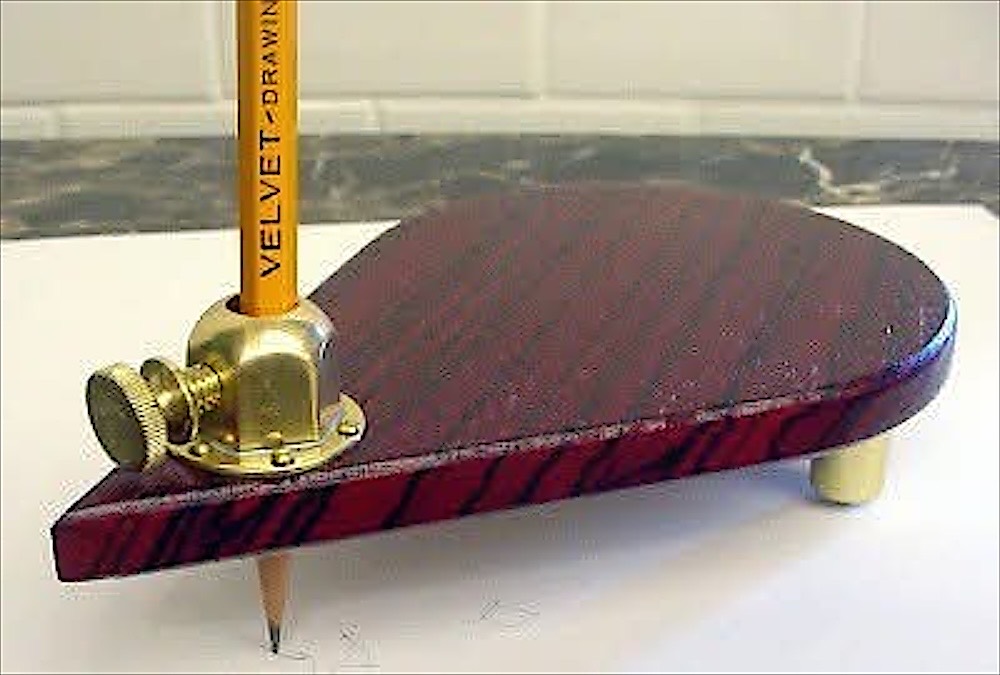
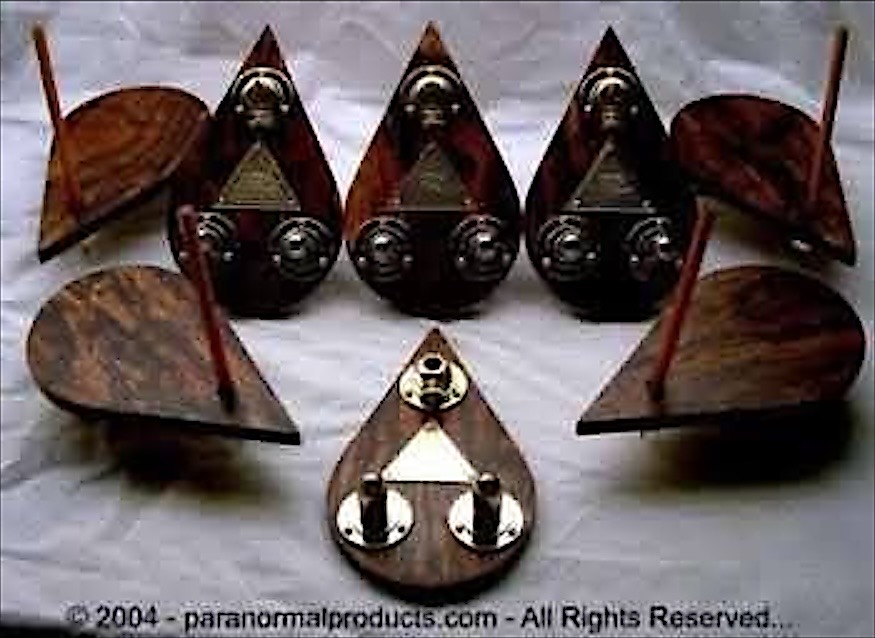
There is no subject on which more has been written by people who knew less. The literature of talking to the dead is a hundred and seventy years of pamphlets by believers who never read a book and sceptics who never sat at a table, and the trade that serves it sells plastic. This page is the correction. It is a history of every method, in the order in which the human race arrived at it, with the evidence stated plainly for each: what was claimed, what was found, and what survives. It is long because the subject is long. It ends with the instruments I make, set apart from everything before them, because that is where they belong.
IBefore Writing
The grave that answers back: Sungir
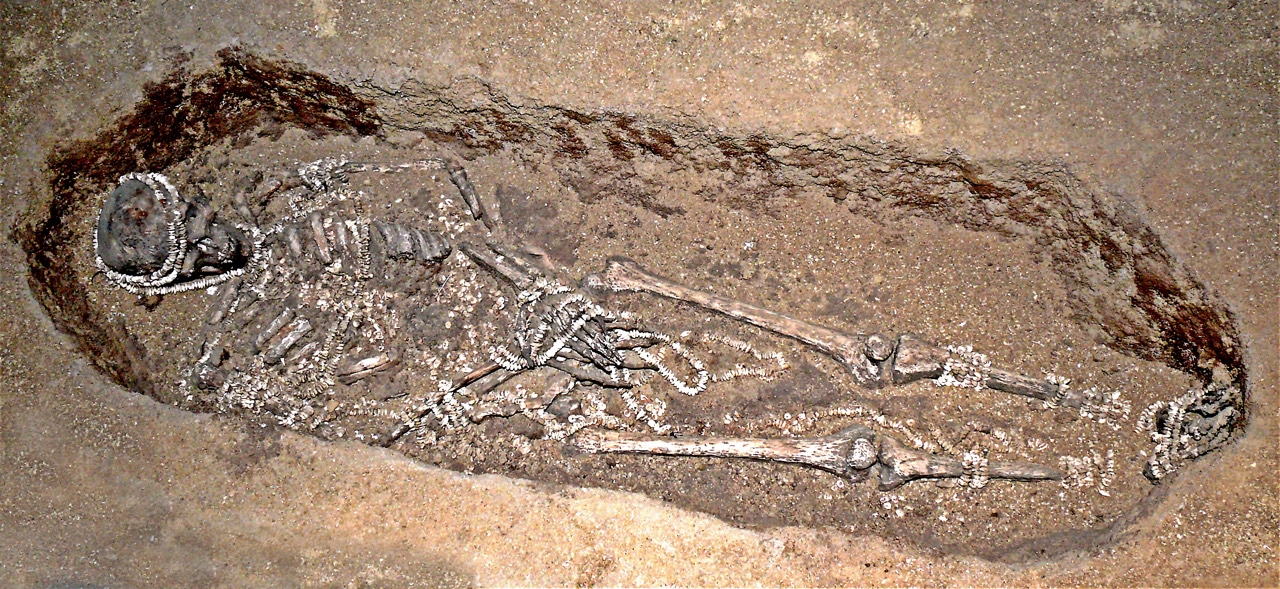
Two children buried head to head on a hill above the Klyazma river, in clothing sewn with thirteen thousand ivory beads, with spears of straightened mammoth tusk laid beside them that took months to make and were never used. Nobody sews ten thousand beads onto a corpse for the corpse. They sew them for the person the corpse still is. The oldest evidence I have of talking to the dead is not a word but a gift, and it is thirty-four thousand years old.
The plastered skulls of Jericho
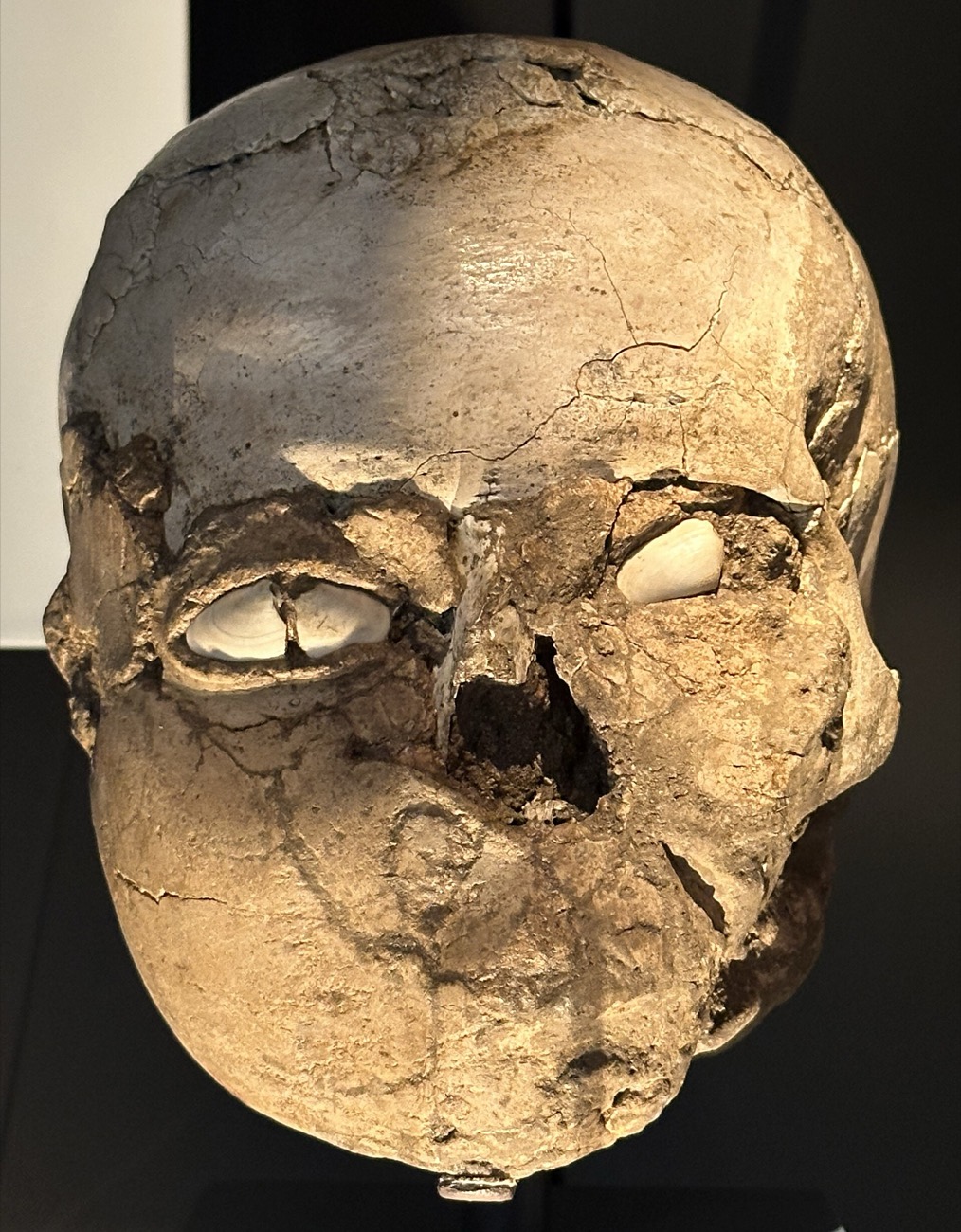
At Jericho, and at Çatalhöyük in Anatolia, the dead were buried under the floors of the houses, and after a time the skulls were dug up, the faces rebuilt over the bone in lime plaster, painted, given eyes of shell, and kept in the room. You ate above your grandmother and consulted her over the fire. This is the ancestor cult in its plainest form, before there were gods to compete with it: the dead stay in the house and the house asks them things.
IIThe Ancient Near East
Enkidu comes up through the hole: Gilgamesh, Tablet XII
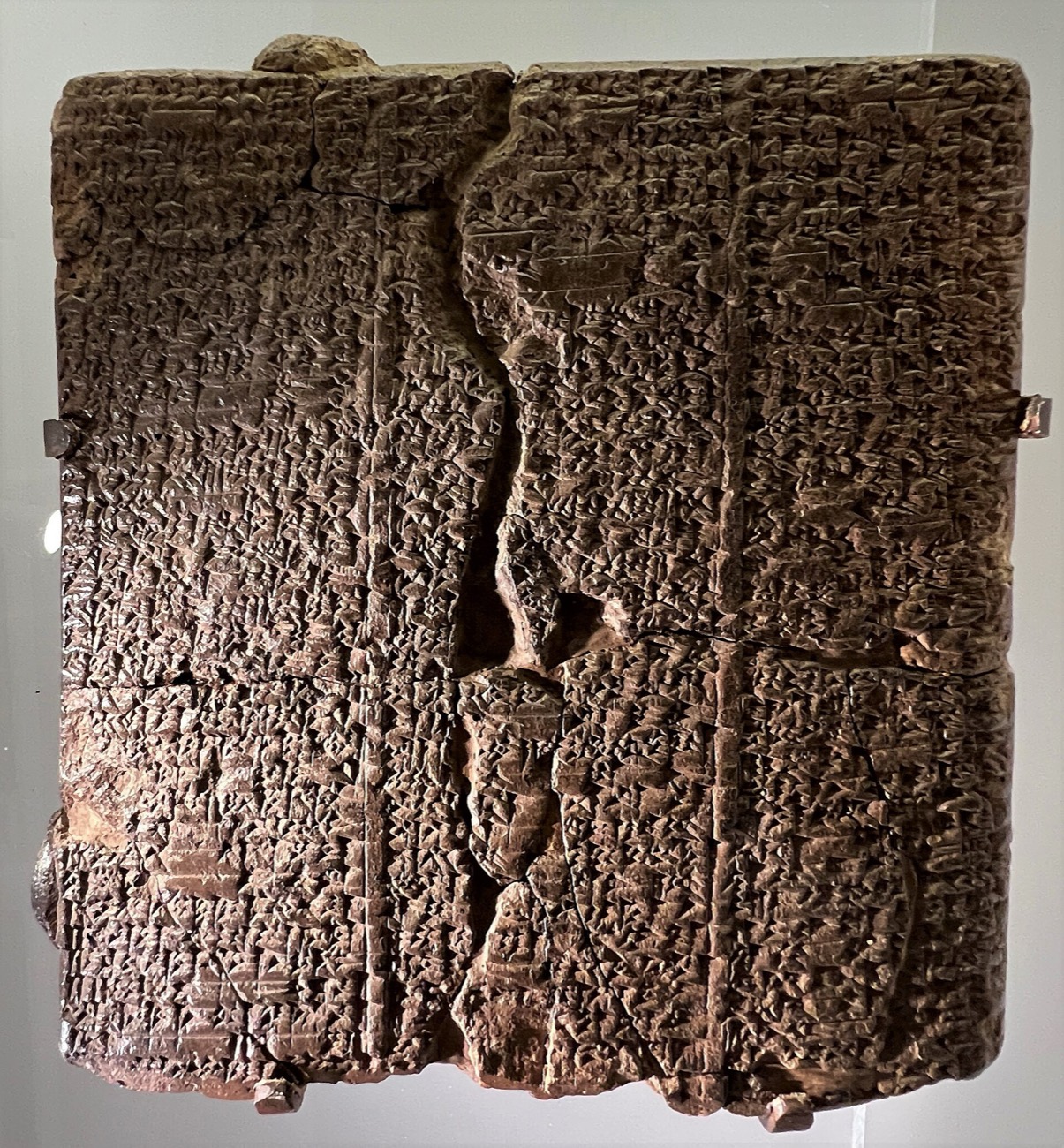
The oldest necromancy in literature. Gilgamesh has lost Enkidu to the underworld and begs the gods for a word with him; Ea persuades Nergal to open a hole in the earth, and the ghost of Enkidu rises through it ‘like a puff of wind’. They embrace. Gilgamesh asks what the underworld is like, and Enkidu tells him, and the news is bad. The scene is Sumerian, older than the Akkadian epic that absorbed it, and it already contains everything the séance would contain four thousand years later: the grief, the petition, the opening, the embrace, and the answer nobody wanted.
Egypt: letters to the dead
The Egyptians wrote to them. A dozen or so survive, written in ink on pottery bowls and linen and left in the tomb chapel where the offering of food was set out, so that the dead would find the letter when they came for dinner: a widow complaining to her husband about a lawsuit, a son asking his father to intercede against a dead servant who is making him ill, a man begging his dead wife to stop haunting him. They are the first documents in which a living person addresses a dead one by name and expects an answer, and they assume a bureaucracy of the afterlife in which the dead can be petitioned, bribed, and sued.
Read: the Cairo Letter to the DeadWatch: Egyptian letters to the dead
China: the ancestors answer in cracks
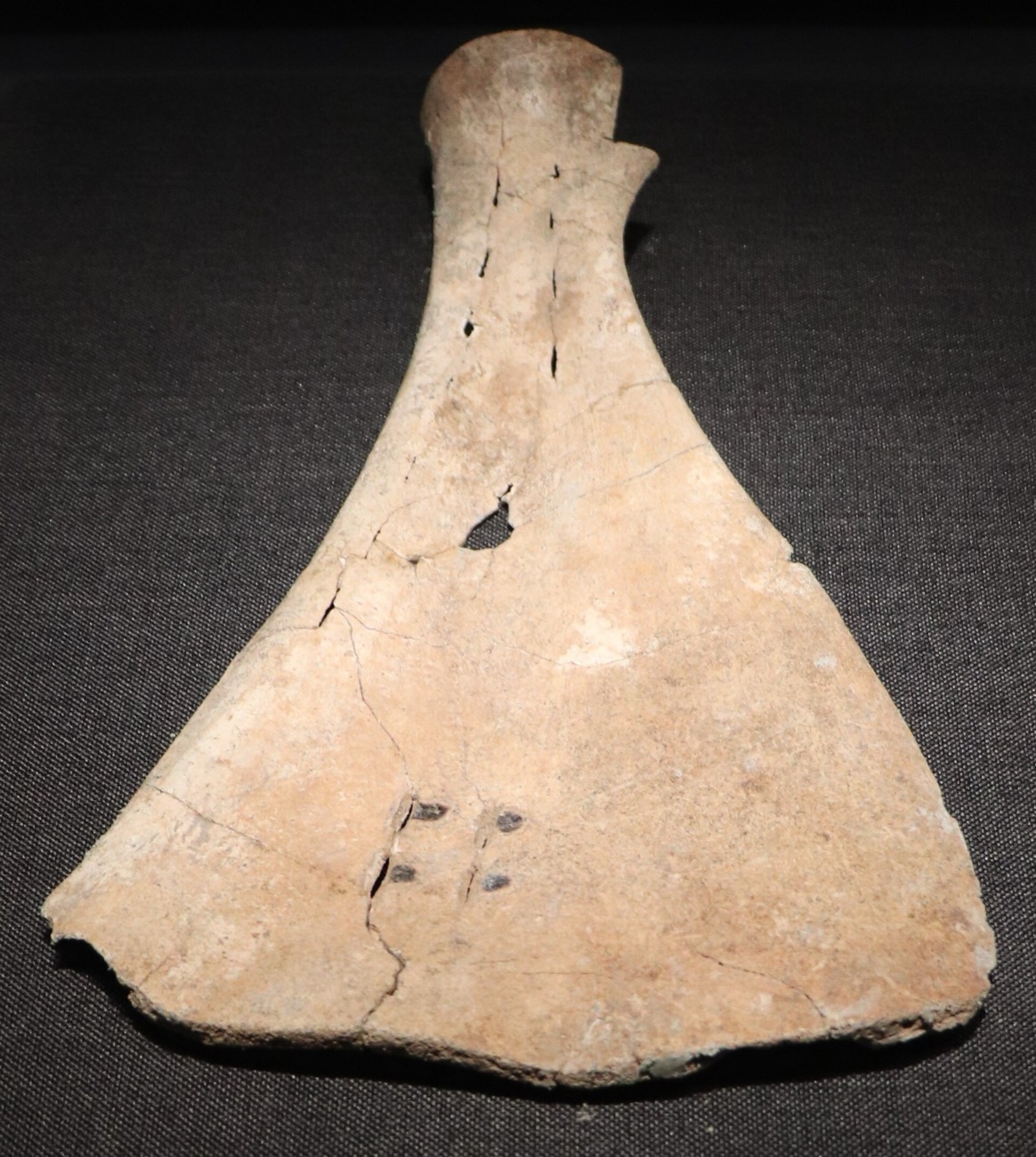
The kings of the Shang drilled an ox’s shoulder-blade, put a hot point to it until it cracked, and read the crack as the ancestor’s reply: yes, no, this many days. Then a scribe cut the question and the answer into the bone. The oldest Chinese writing is the record of a conversation with the dead, and the dead were consulted before every harvest, war, and birth. Three thousand years later the same civilisation was still doing it, with a stylus in a tray of sand.
The medium of Endor
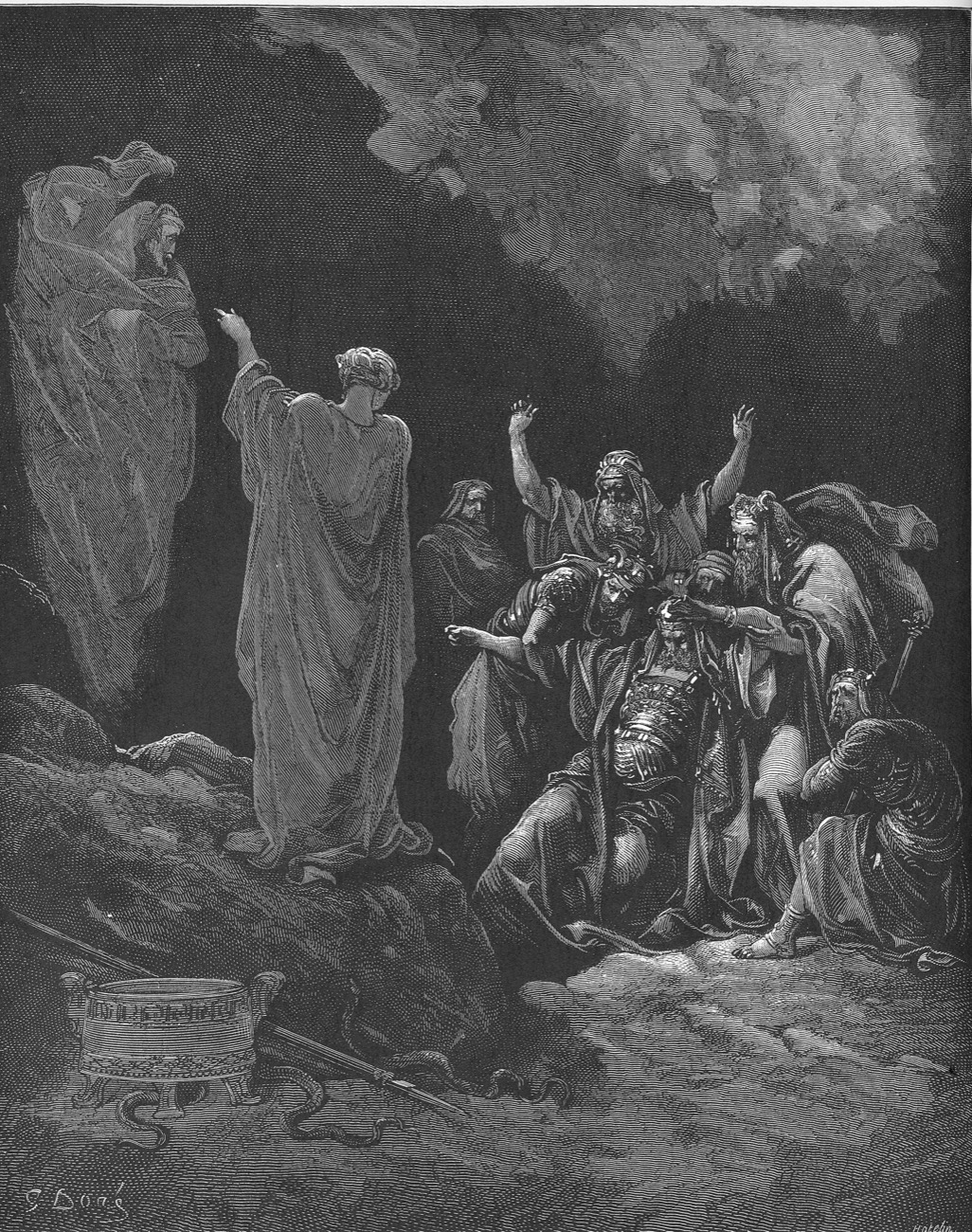
Saul, king of Israel, has outlawed the mediums. On the night before his last battle he disguises himself, goes to a woman at Endor, and asks her to bring up Samuel. She does, and is terrified, because it works: an old man in a robe, who tells the king that by tomorrow he and his sons will be with him. It is the one séance in the Bible, and it is a successful one; the Church has argued for two thousand years about whether the woman raised Samuel or a devil in his likeness, and the spiritualists have pointed out that the text does not hedge. She raised Samuel.
IIIGreece and Rome
Odysseus at the pit: the nekyia
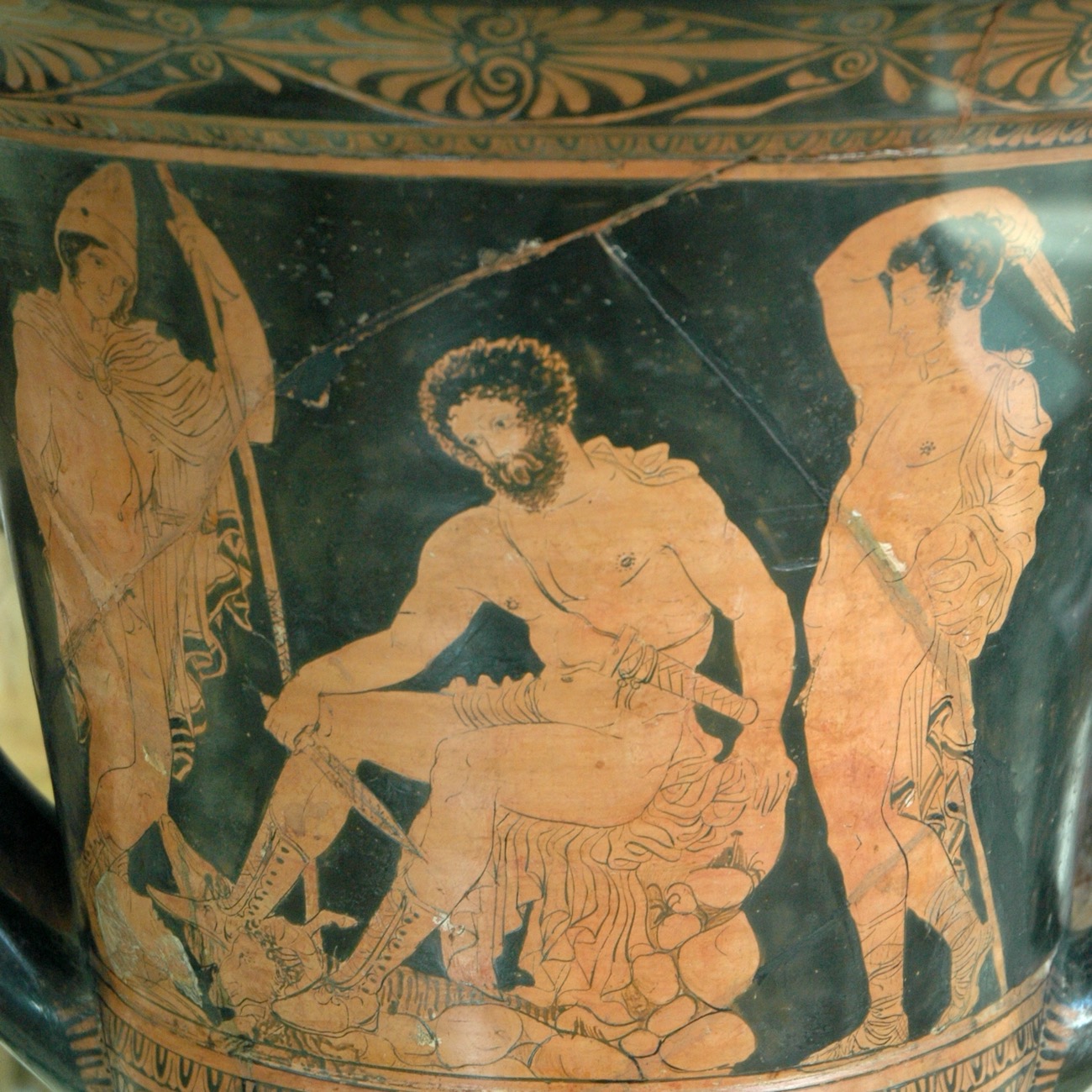
Book XI of the Odyssey is the procedure. Dig a trench a cubit square at the edge of the world; pour in honey and milk, wine, water, and barley; cut the throats of a black ram and ewe so the blood runs into the pit; then hold the ghosts off with your sword until the one you want has drunk, because a ghost that has drunk blood can speak. Tiresias comes and prophesies; then Odysseus’s mother, whom he did not know was dead, and who passes through his arms three times like a shadow. Every later necromancer in the West is following this recipe, and every séance that ends in an embrace that closes on nothing is repeating its last scene.
The Oracle of the Dead on the Acheron

Not a story: a building. At Ephyra in Thesprotia, where the Acheron and the Cocytus meet, the Greeks ran a necromanteion for centuries. Herodotus says the tyrant Periander of Corinth sent there to ask his dead wife Melissa where he had hidden a deposit; she refused to answer until he burned every dress in Corinth for her, because she was cold. The site was excavated in the 1950s: a maze of corridors, a diet of beans and lupins for the pilgrims, and an underground hall where the ghosts appeared, possibly by machinery, possibly by beans. Either way it was a business, with a procedure, a fee, and a waiting list.
Read: Herodotus V.92 (Periander and Melissa)Watch: the Necromanteion
Erichtho: Roman necromancy at its worst
Lucan’s Pharsalia gives the Roman version, and it is the one the horror films come from. The witch Erichtho, on the eve of the battle, chooses a fresh corpse from the field, drags it to her cave, fills it with hot blood and moon-foam and hyena’s marrow, and screams at the gods of the underworld until the soul is forced back into the body to prophesy. The Greeks fed the dead to make them speak; the Romans, in Lucan’s telling, tortured them. The distinction has never gone away, and it is the difference between a séance and an exorcism.
IVThe North and the Middle Ages
The days the dead come home: Obon, Qingming, Día de Muertos
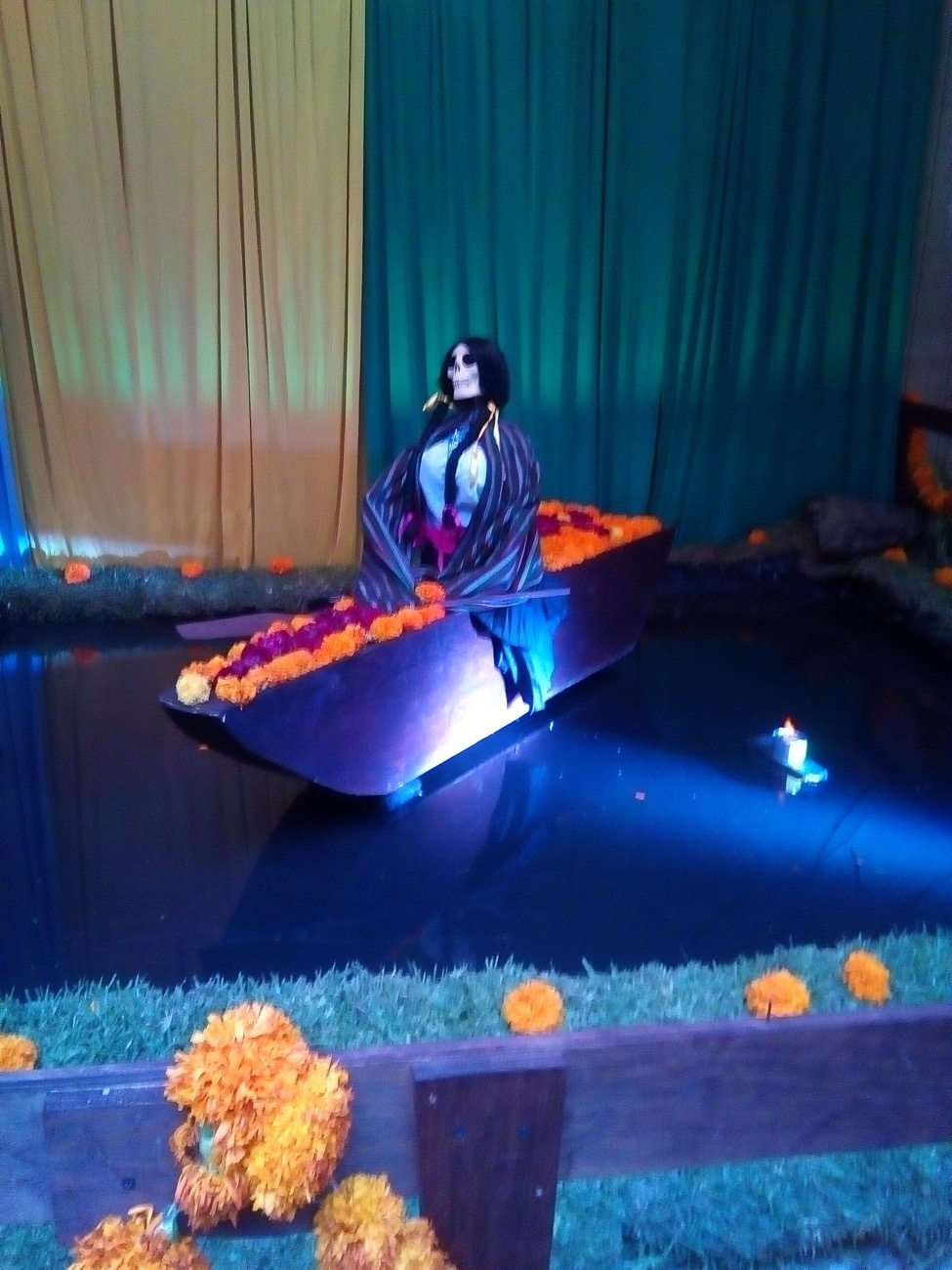
Most of the world never needed a séance because it had a calendar. In Japan, since the seventh century, the dead come home at Obon in August and are lit back to the graves with lanterns; in China at Qingming the tombs are swept and the ancestors fed, and at the Ghost Festival of the seventh month the unquiet dead are fed too, so they will leave; in Mexico the Aztec feast of the dead and the Church’s All Souls fused into the Día de Muertos, with an altar in every house laid with the dead person’s food, drink, and photograph, and marigolds to show them the way. These are not divination. They are hospitality. The dead are not asked anything; they are given dinner. It is the oldest method of all, and the only one that has never been exposed.
Odin wakes the seeress: the Völuspá
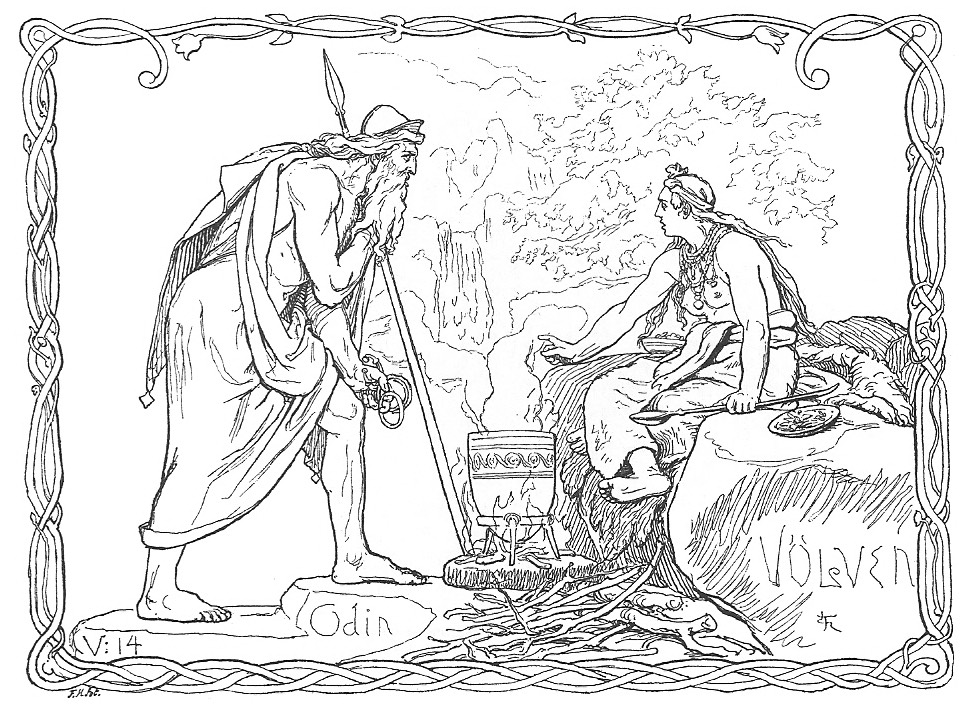
In the North the dead were the best-informed people available, and the gods knew it. Odin rides to the eastern gate of Hel, sings the corpse-waking spell over a dead völva, and she rises, angry, to prophesy the end of the world; in the Hávamál he boasts that he knows a rune to make a hanged man walk down and talk with him. Seiðr, the Norse trance-craft, was women’s work and disreputable for men, which did not stop the king of the gods.
China: the stylus in the sand
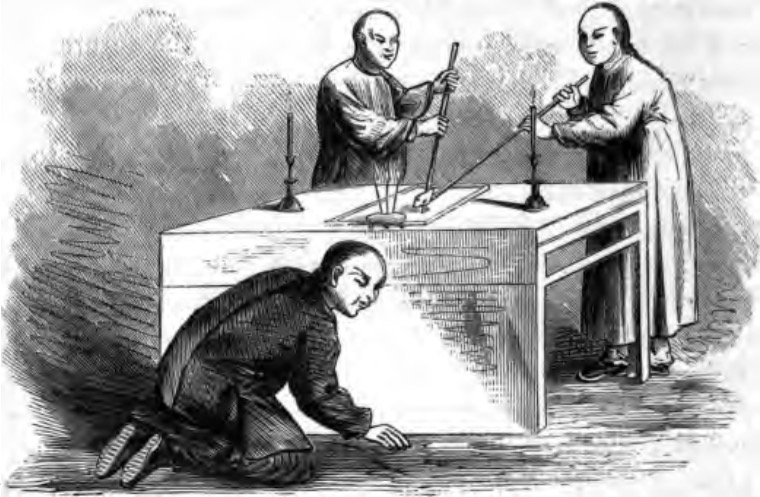
While Europe forbade it, China professionalised it. Fuji, spirit-writing, hung a forked stylus from a frame or held it between two people over a tray of sand or incense ash; a deity or immortal was invited, the stylus moved, a reader called the characters, a scribe wrote them down and smoothed the sand. Shen Kuo describes it in 1088; the Ming and Qing scholars consulted it before their examinations; whole scriptures were published from it by the charity halls of Shanghai in the 1880s. It is the automatic-writing planchette, complete, five centuries before Paris, and the only method on this page that produced a literature.
The clerical underworld: necromancy by the book
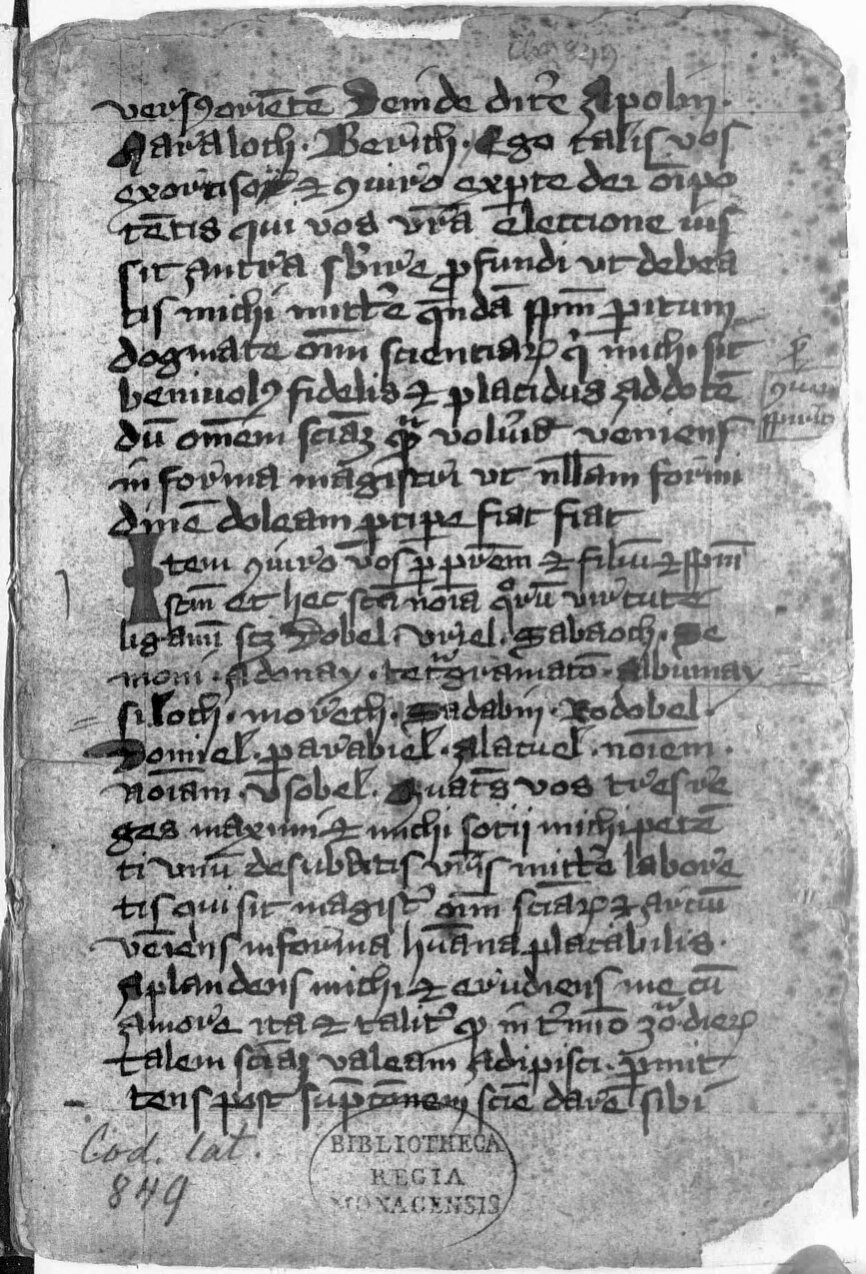
The medieval Church forbade it, which tells you it was being done, and the people doing it were clerks, because the books were in Latin. The so-called Munich Manual of Demonic Magic, a fifteenth-century handbook, gives circles, names, and prayers for compelling spirits to appear in a boy’s fingernail or a basin of water and answer questions, and for raising the appearance of the dead. It sits in the Bavarian State Library next to the psalters. Meanwhile, at Byland Abbey in Yorkshire, a monk wrote down a dozen local ghost stories around 1400, in which the dead are met on the road, wrestled, and asked what they want, which is usually a Mass.
VRenaissance to Enlightenment
Dr Dee and the shew-stone
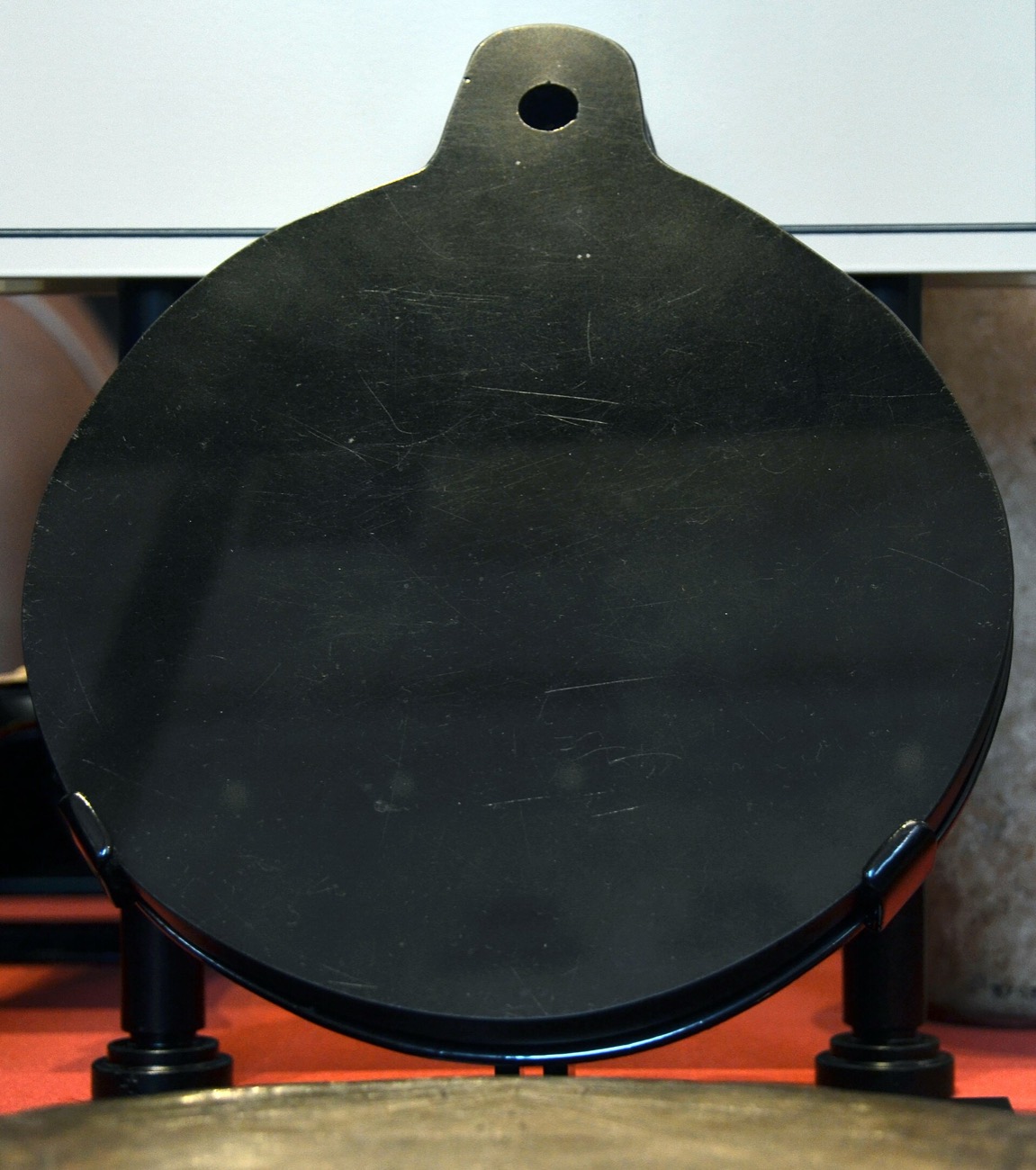
John Dee, mathematician to Queen Elizabeth, could not see spirits himself, so he hired men who could. The best of them, Edward Kelley, sat before an obsidian mirror brought from Aztec Mexico and a crystal ball on a table of wax, and dictated what the angels showed him, for seven years, in a language they called Enochian, while Dee wrote it all down. The angels’ instructions ended with the two men sharing their wives. Dee kept every page. The mirror is in the British Museum; Horace Walpole owned it and labelled it ‘the black stone into which Dr Dee used to call his spirits’. It is the direct ancestor of every crystal ball and black mirror sold today, and of the séance principle that one person looks and another records.
Read: Dee’s spiritual diaries (Casaubon, 1659)Watch: John Dee’s mirror
Swedenborg goes to heaven and takes notes
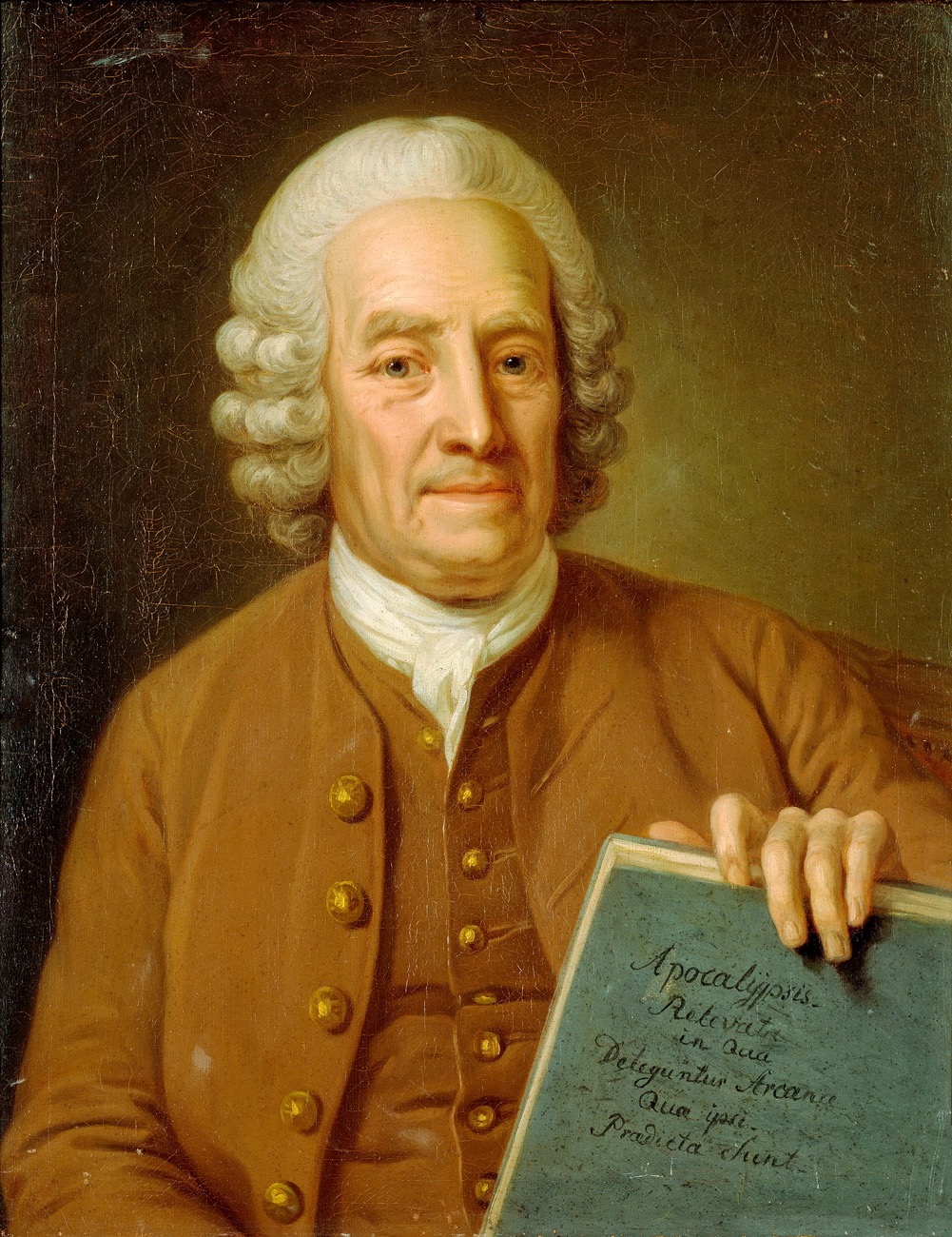
The first modern medium was a Swedish mining engineer of impeccable respectability who, at fifty-six, began to converse with angels and the dead as a matter of daily routine, and wrote twenty volumes about it in Latin. He described the afterlife as a place where you keep learning, keep working, and can be spoken to; he told the Queen of Sweden a secret only her dead brother knew; and Kant wrote a whole book failing to decide whether he was a fraud. Spiritualism a century later took its map of heaven from him and called him its founder.
The Cock Lane ghost: London learns to count raps
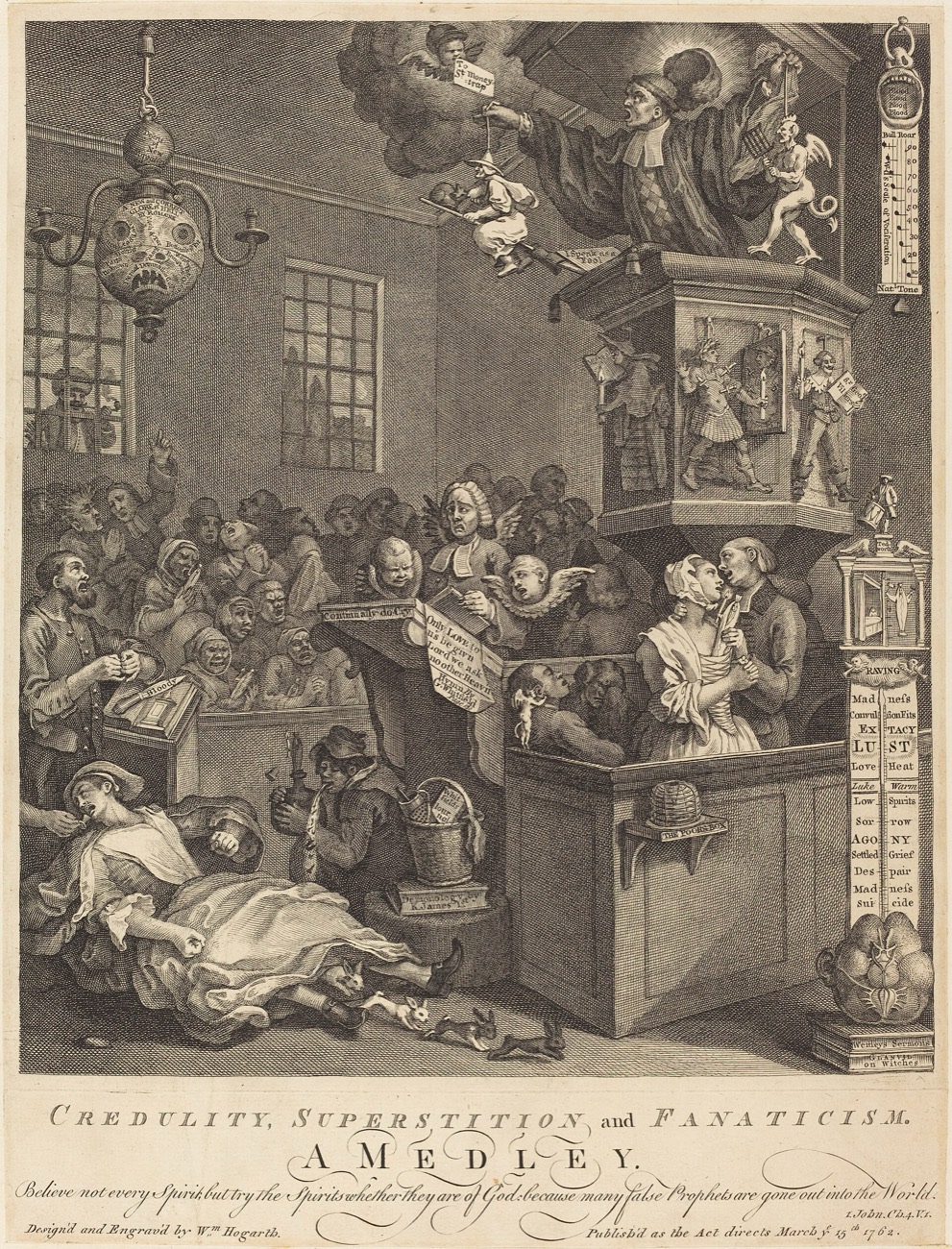
Before Hydesville there was Cock Lane. A dead woman named Fanny began knocking in a lodging-house off Smithfield, and through the twelve-year-old daughter of the house answered questions by raps, one for yes and two for no, accusing her lover of poisoning her. Half of London queued in the street; Dr Johnson sat up with a committee to test it; Hogarth put the ghost into his print on credulity; and the girl was found to be knocking on a board under the bedclothes. The rapping code, the child medium, the committee, the exposure, the print: the whole of 1848 was rehearsed eighty-six years early.
Mesmer’s tub, and the trance
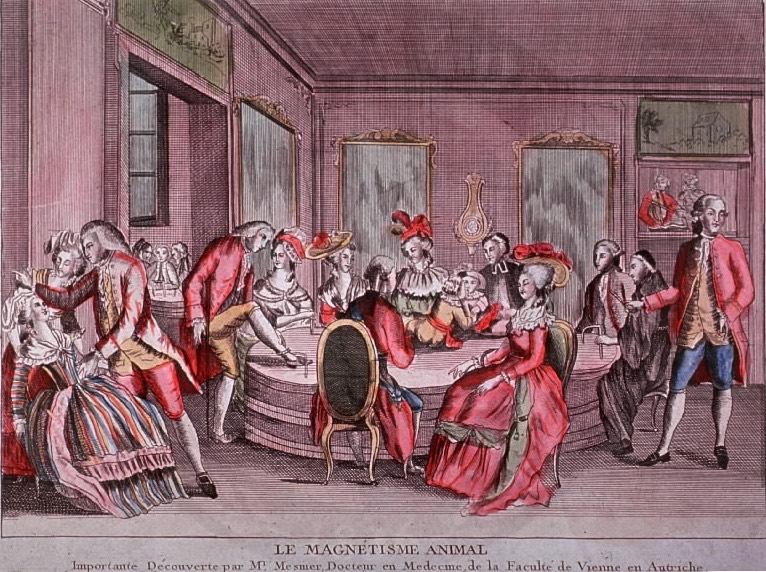
Franz Anton Mesmer did not talk to the dead. He put people into a state in which they later would. His Paris clinic sat patients round a tub of magnetised water holding iron rods, and sent them into convulsions and trances by the pass of a hand; his followers found that a magnetised subject could see through walls, diagnose illness, and, by the 1840s, converse with spirits. The trance medium is Mesmer’s patient with the tub taken away.
VIThe Spiritualist Century
Hydesville: the night it became a movement
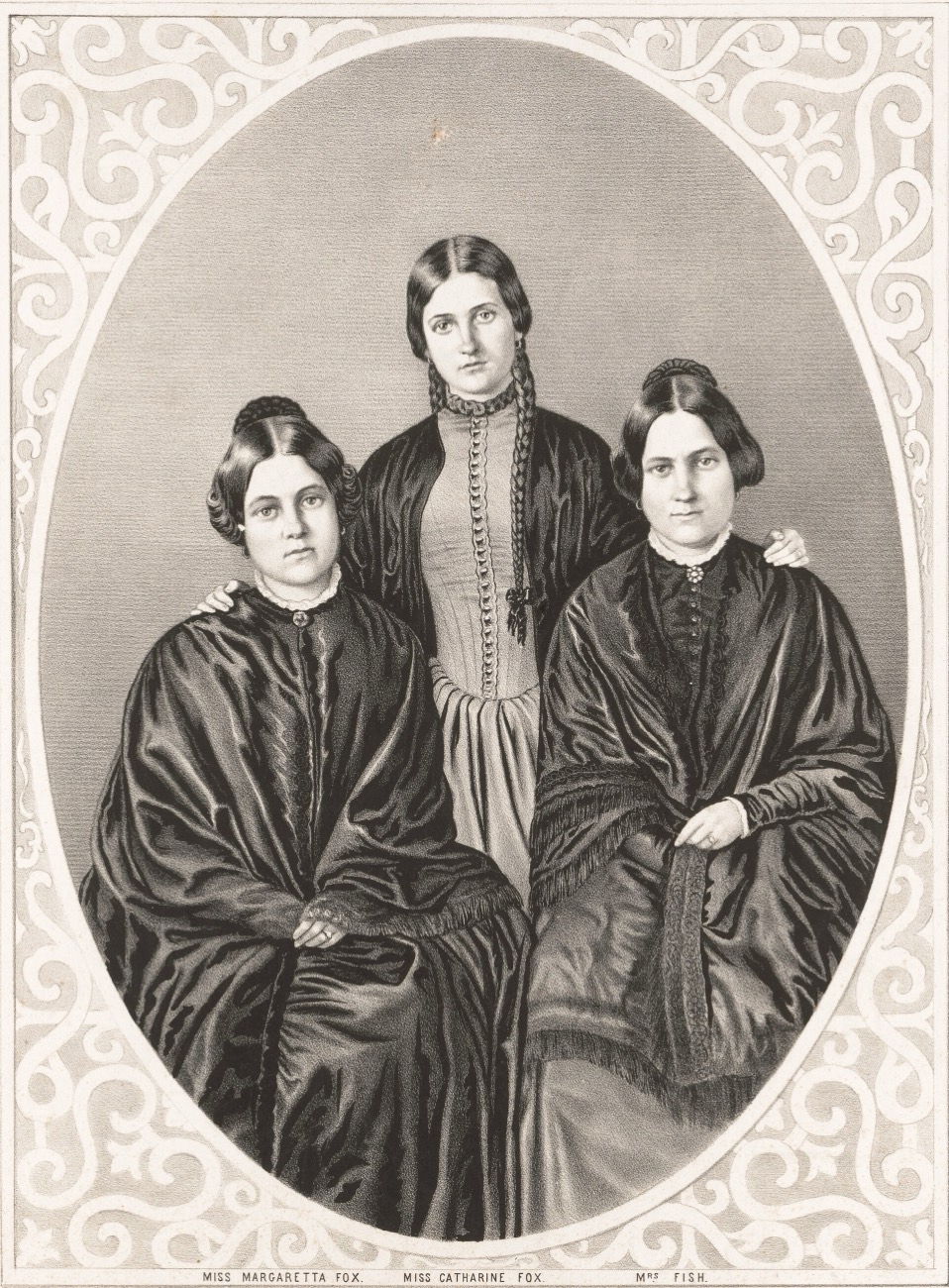
Two girls in a frame house in Wayne County, New York, get answers by knocking from something in the walls. ‘Mr. Splitfoot, do as I do.’ A code is agreed in the kitchen that night: one rap for no, three for yes, and the alphabet recited aloud for words. The neighbours come, then Rochester, then the world. Within five years there are circles in every town in the Union and in London and Paris, and a religion has begun that will bury its founders in Lily Dale and still be holding services in 2026. Everything on this page after this date is a faster way of doing what Kate and Maggie Fox did with a knock.
Watch: the Fox sistersRead: Modern Spiritualism (Britten, 1870)
The tables turn, and the planchette is born
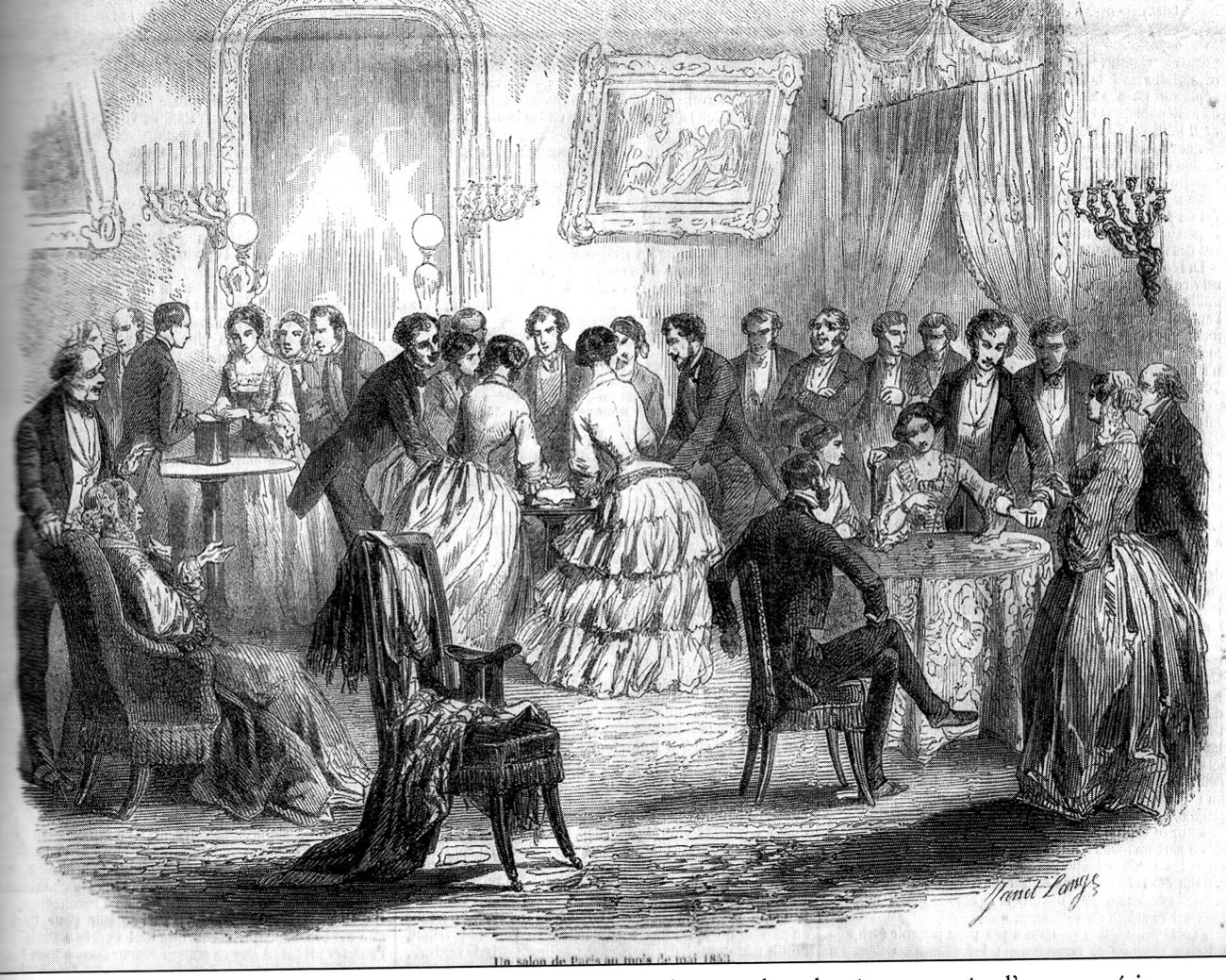
The craze crosses the Atlantic. In Paris in April 1853 everyone from the Empress to the concierge is sitting round a small table with their hands on it, waiting for it to tilt and rap out the alphabet. Within months someone fixes a pencil to an upturned basket, the corbeille-à-bec, and then makes a small board on castors with the pencil through it: the planchette, which writes. Allan Kardec systematises the whole practice in the Livre des Esprits (1857) and the Livre des Médiums (1861). Daumier draws the tables turning. The Church draws the line.
The Davenport brothers and the spirit cabinet
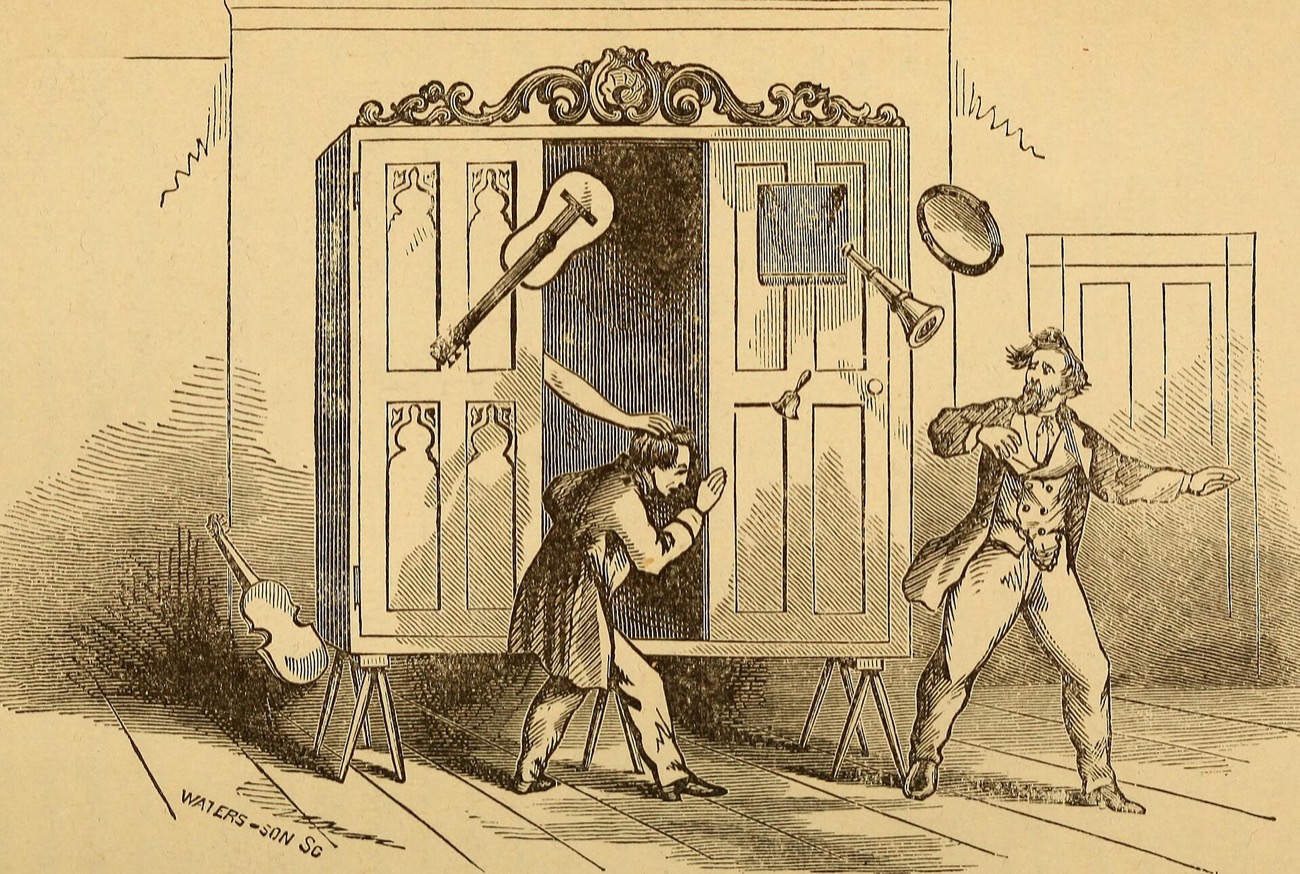
Two boys from Buffalo are tied hand and foot inside a wardrobe with a guitar, a tambourine, and a trumpet; the doors close; the instruments play and fly; the doors open; the boys are still tied. They toured for thirty years, were mobbed in Liverpool, and were studied by Houdini, who befriended the surviving brother in 1910 and learned the rope trick from him. The cabinet became the standard furniture of the physical séance, and the trumpet in it became the spirit trumpet through which the dead were heard to speak in dark rooms for the next seventy years.
Professor Hare builds the Spiritoscope
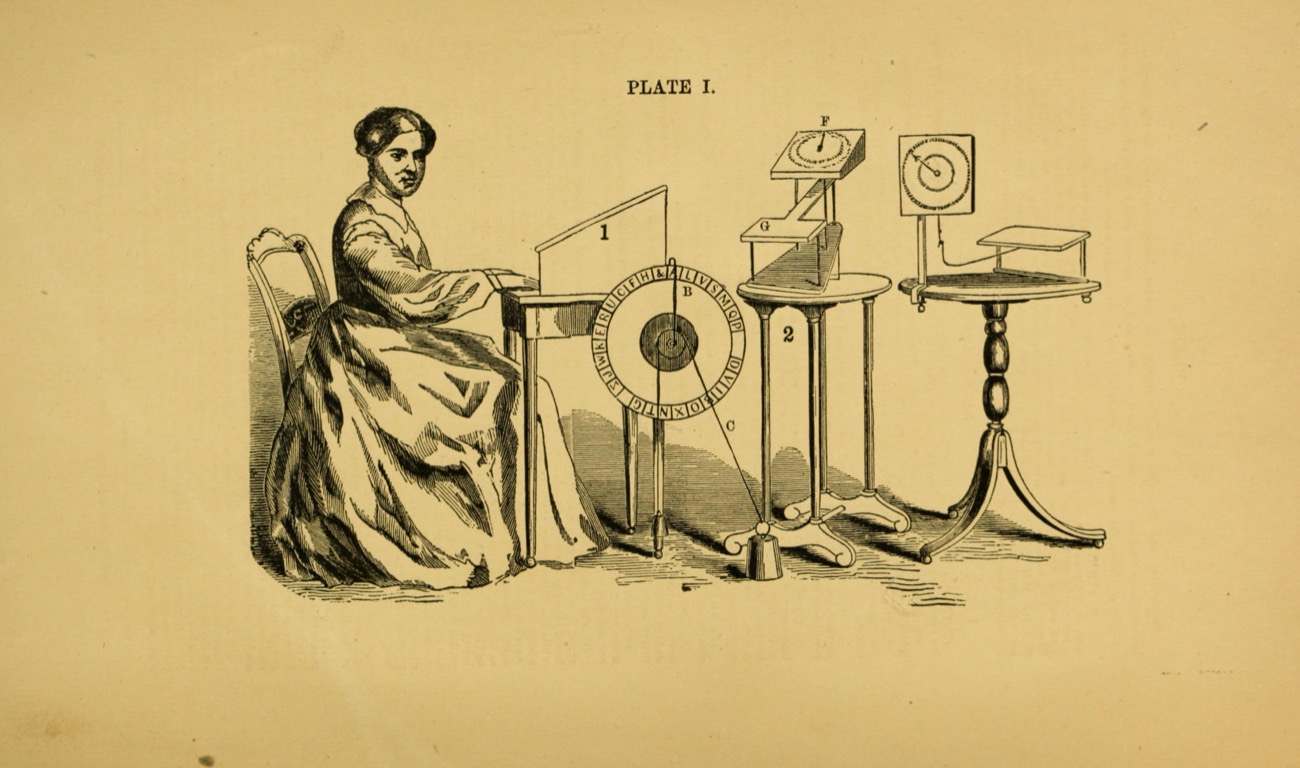
Robert Hare, Emeritus Professor of Chemistry at the University of Pennsylvania and inventor of the oxy-hydrogen blowpipe, set out at seventy-three to expose the spirit-rappers with laboratory apparatus, and published Experimental Investigation of the Spirit Manifestations to say that they had converted him. His instruments were the first talking boards built by a scientist: a lettered disk turned by a weighted cord so the medium could not see the letters; a table on wheels; a hydraulic balance under a wire cage that measured, in pounds and ounces, a force no hand was touching. The plates are on this page, and the instruments are made again, to his drawings, at Spiritoscopes.
Kardec writes the rulebook
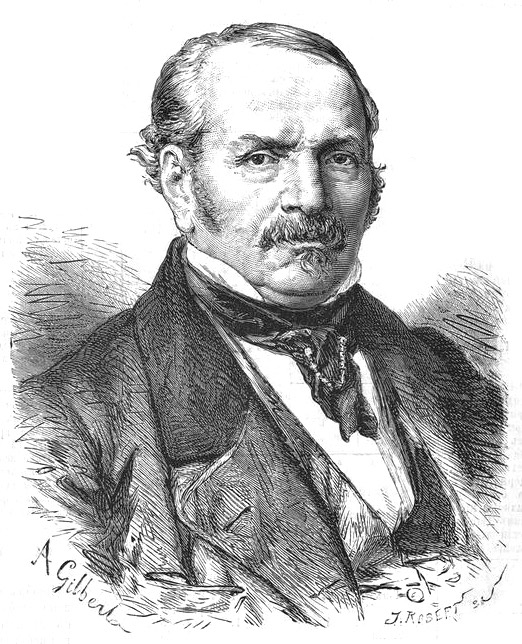
Hippolyte Rivail, a Lyon schoolmaster who took the name Allan Kardec from a former life, spent four years putting a thousand and nineteen questions to spirits through mediums and published the answers as The Spirits’ Book, then wrote The Mediums’ Book to say exactly how it was to be done: the basket with a beak, the planchette, the kinds of medium, the questions not to ask, the signs of a frivolous spirit. He is unromantic and precise, and his spiritism is a religion of millions in Brazil today. The Bishop of Barcelona burned three hundred of his books in the public square in 1861, which is the only edict on the planchette that ever existed.
D. D. Home: the medium nobody caught
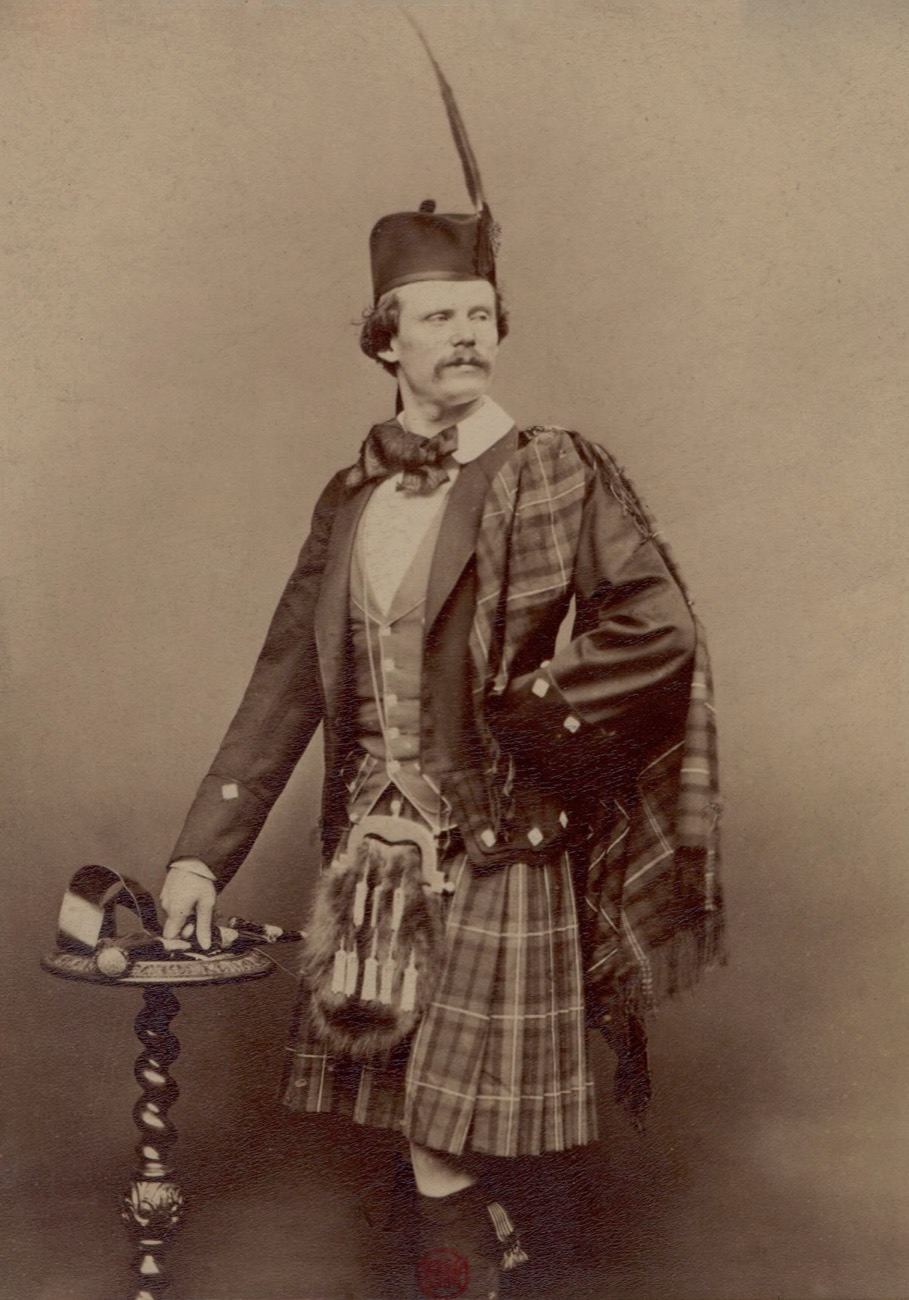
Daniel Dunglas Home floated out of one third-floor window and in at another in front of three witnesses, handled hot coals, stretched himself eleven inches, and made accordions play inside cages, in lit rooms, for emperors and for Sir William Crookes, who measured the force on a balance and published it. He was never exposed, never charged for a séance, and was sued only once, by a widow who had given him money. Browning hated him and wrote ‘Mr Sludge’; Elizabeth Barrett Browning believed. He is the hard case for every sceptic, and the standard for every medium since.
Mumler and the spirit photograph
A Boston engraver named William Mumler develops a self-portrait and finds a dead cousin standing beside him. Within a year he is charging ten dollars a sitting for portraits with a ghost in them, and in 1872 Mary Todd Lincoln sits for him in mourning and receives a picture with the late President’s hands on her shoulders. He was tried for fraud in 1869 and acquitted; the technique was double exposure, and the profession lasted until the 1930s, when the Crewe Circle in England was doing the same thing with pre-exposed plates. The camera was supposed to be the instrument that could not lie, and it lied for seventy years.
Planchette mania
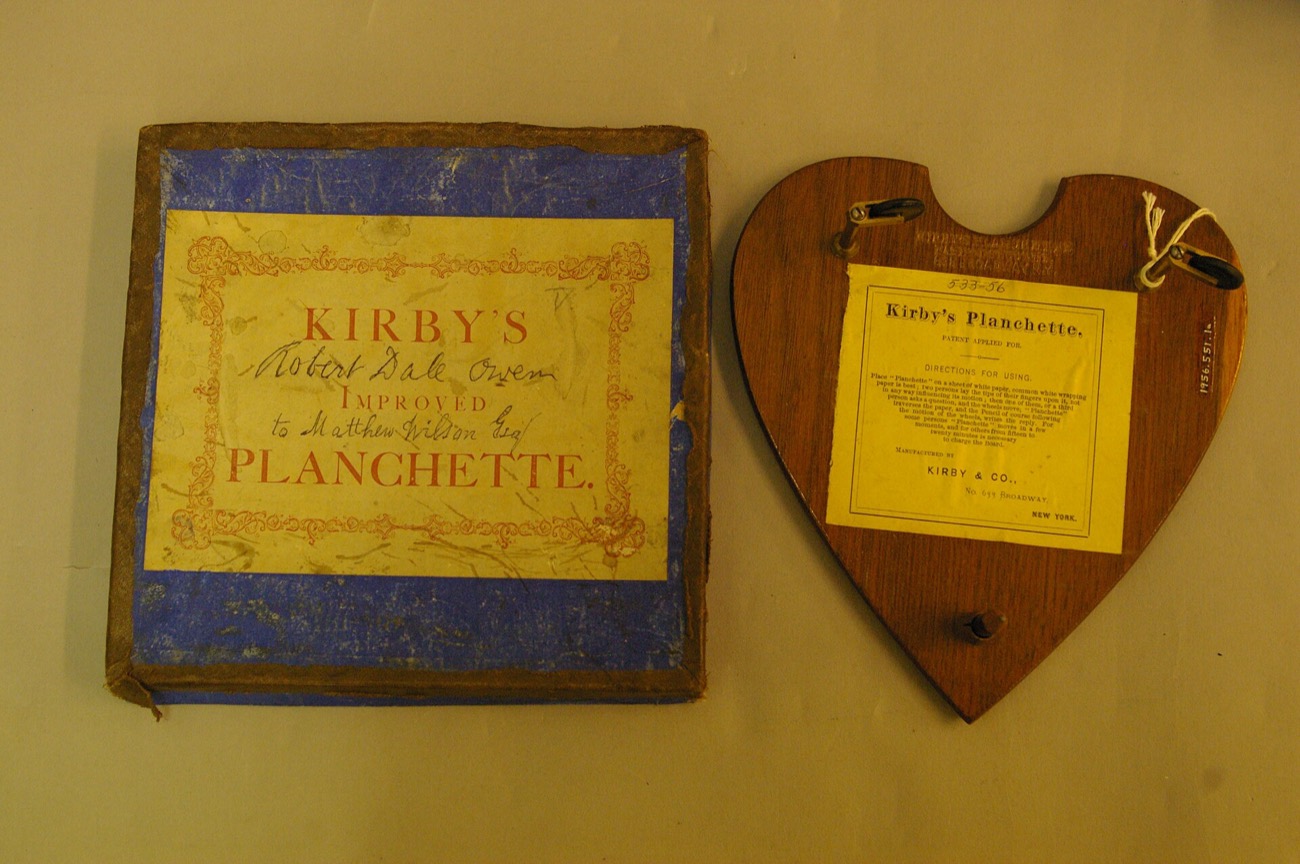
The French writing-board reaches America and sells several hundred thousand copies in a season. Kirby & Co. of Broadway, Cottrell of Boston; walnut, rosewood, and solid glass; a dollar to five. Epes Sargent writes a three-hundred-page book called The Despair of Science to explain it. The instrument in the photograph belonged to Robert Dale Owen, the spiritualist congressman. Its castors are perished and its pencil rides up; it was made for a season. The automatic-writing planchette as it should have been made is at Planchettes.
Read: Sargent, Planchette (1869)The planchette, made properly
Katie King walks out of the cabinet
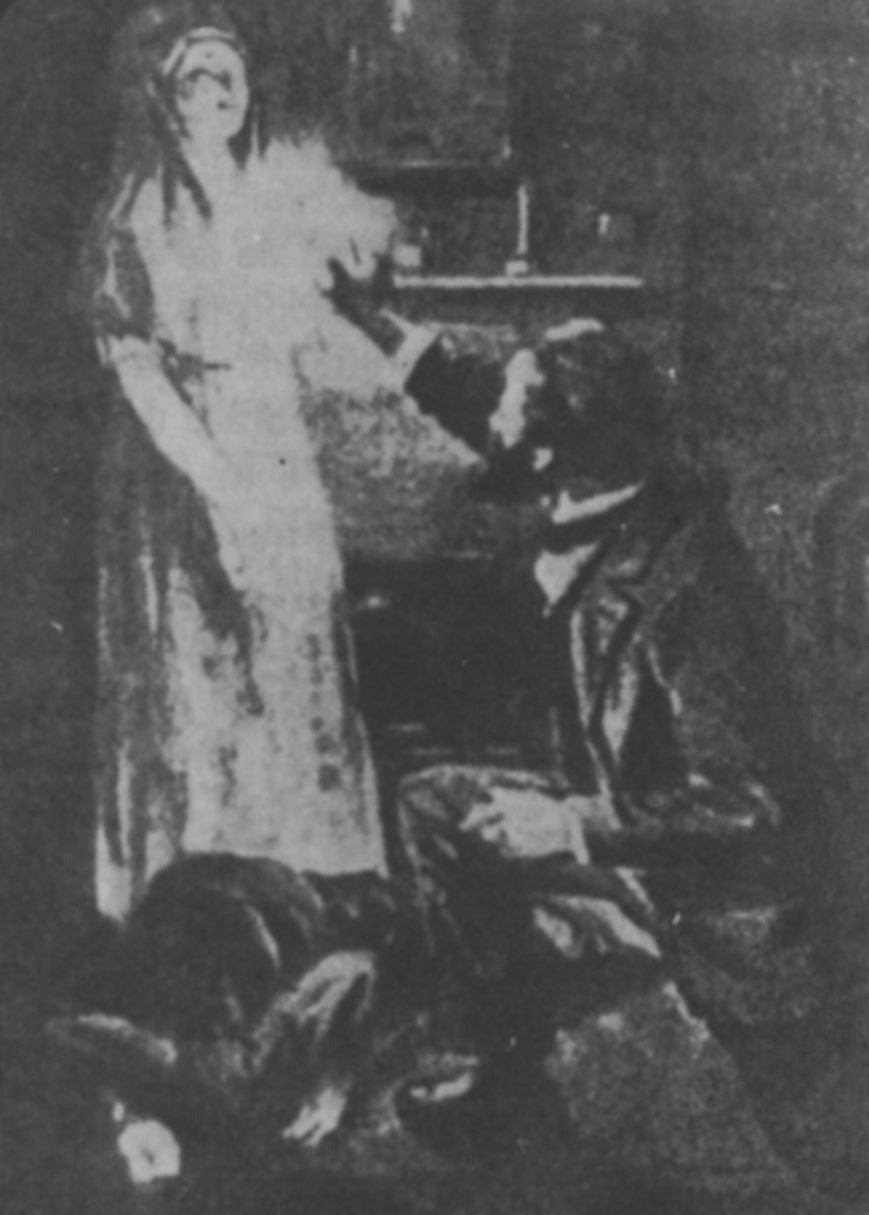
In a house in Hackney, a fifteen-year-old medium named Florence Cook sits tied in a cabinet, and out of it, in full form, walks a woman who calls herself Katie King, talks, lets herself be photographed, and holds Sir William Crookes’s arm while he checks her pulse. Crookes took forty-four photographs and published that she was real. Nobody has ever proved what happened in that room, and the materialisation séance it inaugurated, the full-form ghost in white in the dark, became the highest and most fraudulent art of the movement.
Slate-writing: Henry Slade
Two school slates, a fragment of pencil between them, held under the table; a scratching sound; a message from the dead in chalk. Slade was the master of it and was prosecuted in London in 1876 after the zoologist Ray Lankester grabbed the slate before the writing was supposed to have happened and found it already written. He was convicted, appealed on a technicality, fled to Germany, and converted the physicist Zöllner there, who decided the spirits worked in the fourth dimension. Slate-writing is direct writing: the dead hold the pencil. It is the automatic-writing planchette with the medium’s hand taken away, and it was almost always a trick.
Read: the Seybert Commission report, 1887Watch: slate writing
Mrs Piper, and the scientists’ medium
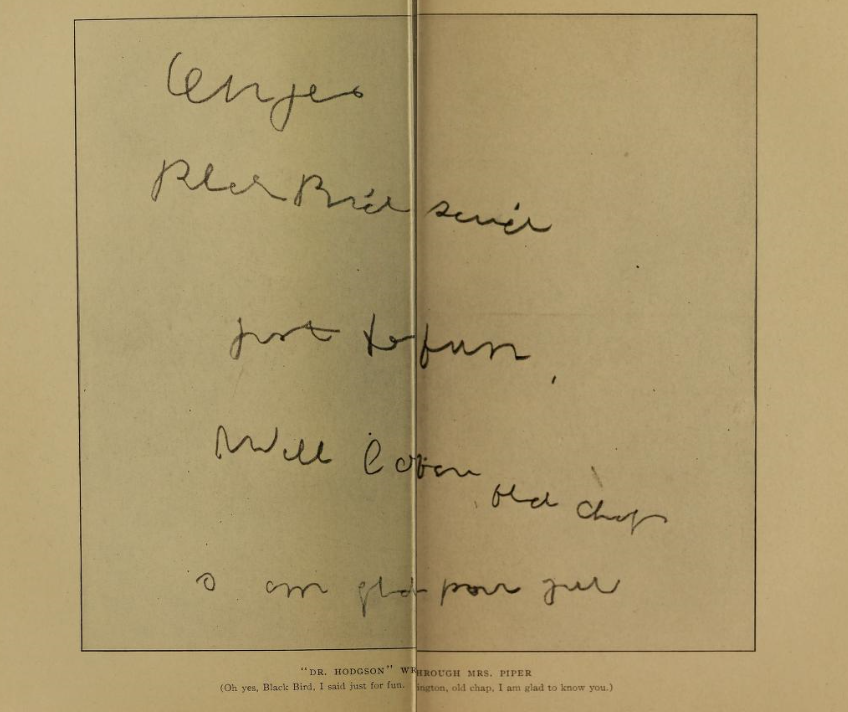
Leonora Piper of Boston went into trance and other people spoke through her, and for twenty-five years the Society for Psychical Research paid her a salary to be studied. William James called her his ‘white crow’: the one case that proved not all crows are black. She was followed by detectives, her mail was read, her sitters were introduced under false names, and she still produced things the investigators could not explain; she also produced a great deal of nonsense, and said herself she did not know whether spirits were involved. Later she wrote instead of speaking, the pencil moving in her hand while she was elsewhere. That is automatic writing, and the SPR’s ‘cross-correspondences’, thousands of pages of it from several automatists on two continents, seeming to complete one another’s classical quotations, are still the most serious evidence the movement ever produced.
Ouija: the board becomes a product

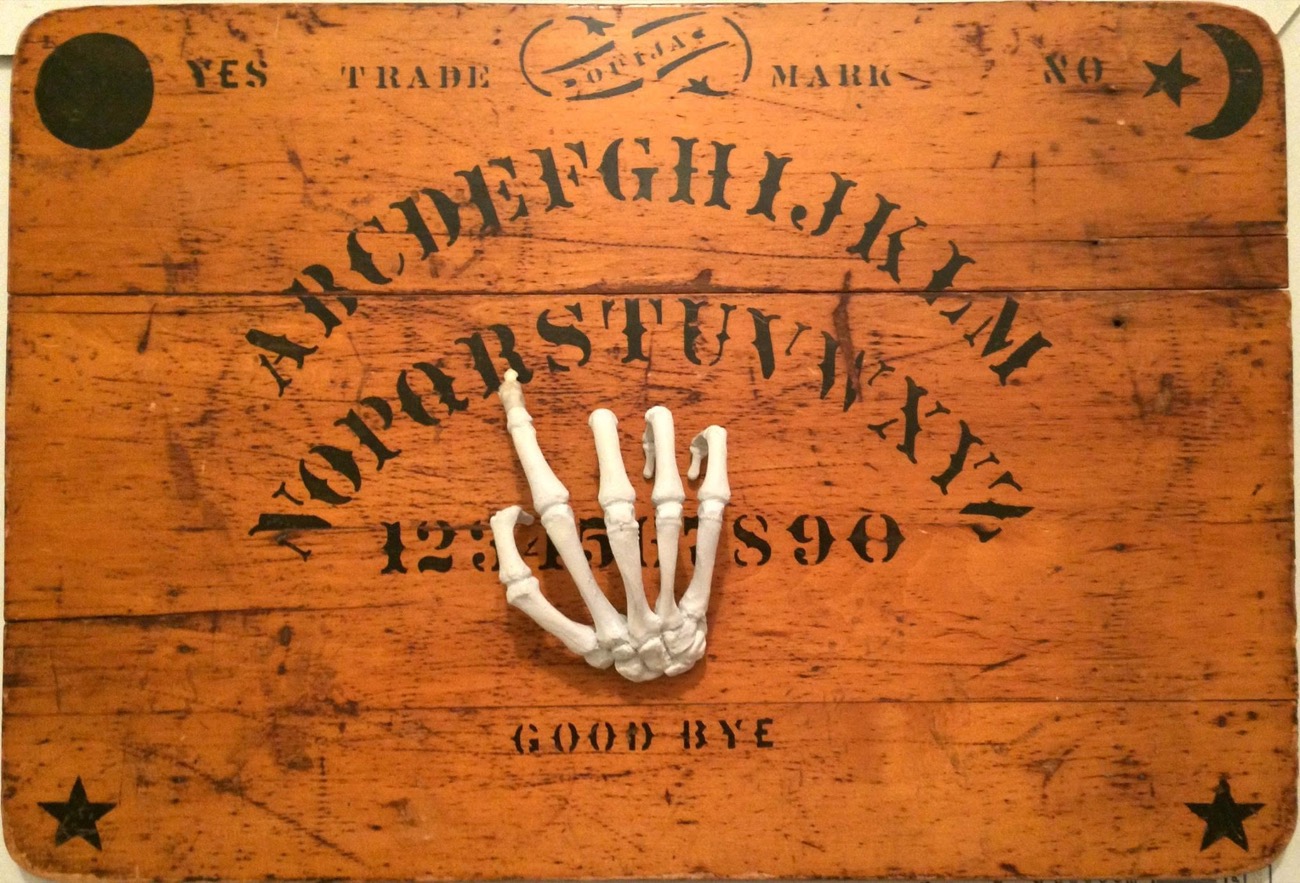
Ohio spiritualists had painted the alphabet on a board and let the planchette point at it since the mid-1880s. In 1890 the Kennard Novelty Company of Baltimore patented it as a toy; Helen Peters asked the board its name and it said OUIJA; William Fuld built a factory for it and died falling off the roof; Parker Brothers bought it in 1966 and outsold Monopoly in 1967; The Exorcist in 1973 gave it to horror; Hasbro makes it now in glow-in-the-dark plastic. It is the most successful instrument for talking to the dead ever made and, as sold, one of the worst: a printed board and a plastic pointer that moves whether anything moves it or not. The board is on this page; what a pointer should be is at Planchettes and Skeletal Planchettes.
Watch: the history of the Ouija boardThe pointer, made properlyThe hand of bone
The rapping table, the nodding skull: the theatre answers
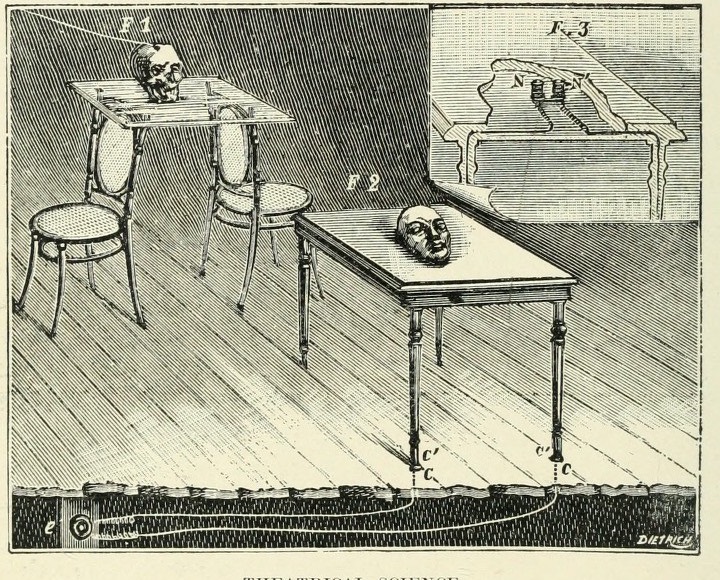
The stage magicians took the raps up at once, because a rap is a wonderful thing in a theatre. Robert-Houdin’s enchanted death’s head nodded its answers on a glass plate; the Isola brothers’ mask rocked on an electromagnet; the magic-shop catalogues sold rapping hands. By 1897 Hopkins’s Magic printed the wiring diagram for a spirit-rapping table. The conjurers exposed the mediums and copied them in the same breath, and the two trades have never been separable since. Houdini was a member of both.
Patience Worth, and ectoplasm
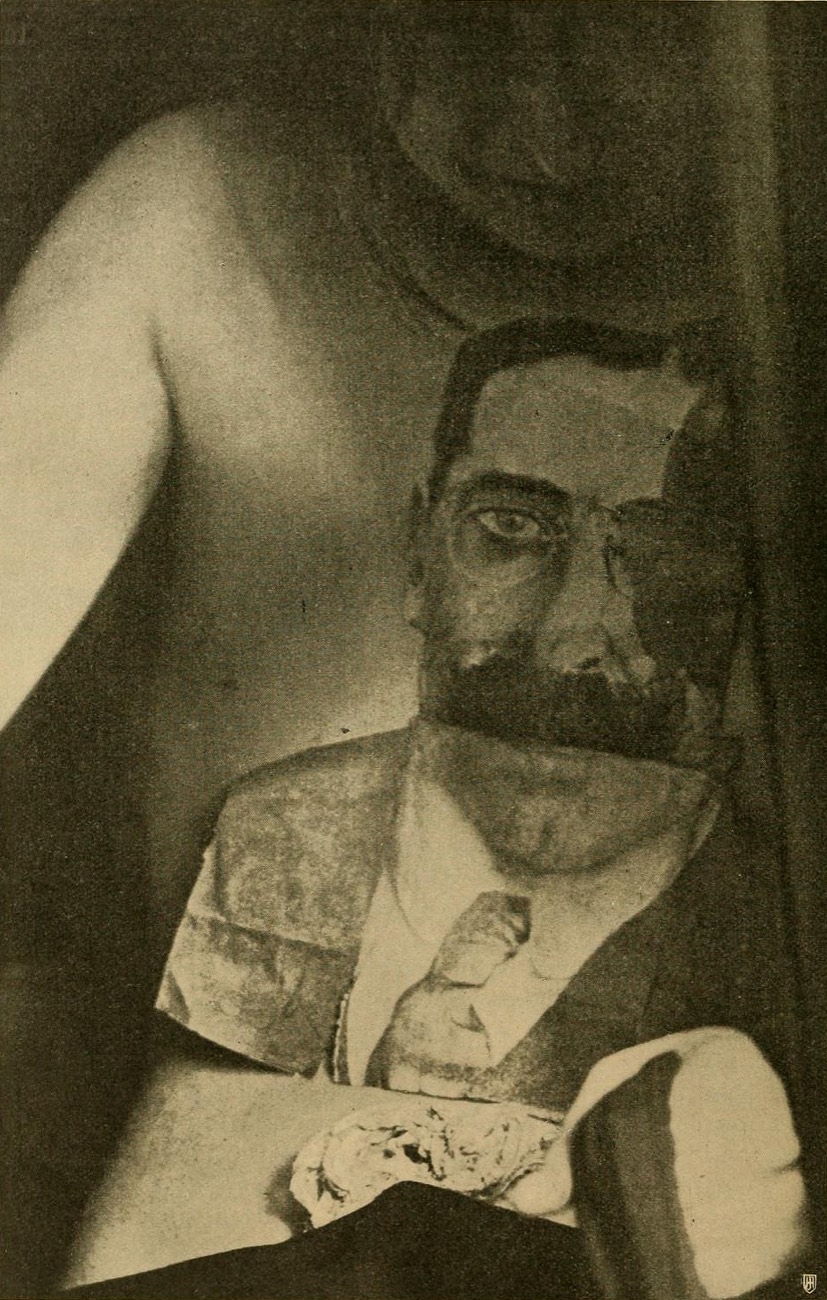
Two things in one year. In St. Louis a housewife named Pearl Curran receives, through a Ouija board, a spirit calling herself Patience Worth, who over the next twenty-four years dictates novels and poems in a seventeenth-century English that critics praised and Curran could not have written, and which fill twenty-nine volumes. And in Paris the medium Eva C. is photographed producing ectoplasm, a pale substance that came out of her mouth and formed faces, under the eye of Dr Schrenck-Notzing, who searched her before and after. The faces turned out to be cut from a magazine. Patience Worth has never been explained.
VIIThe Electric Dead
Edison’s apparatus for talking with the dead
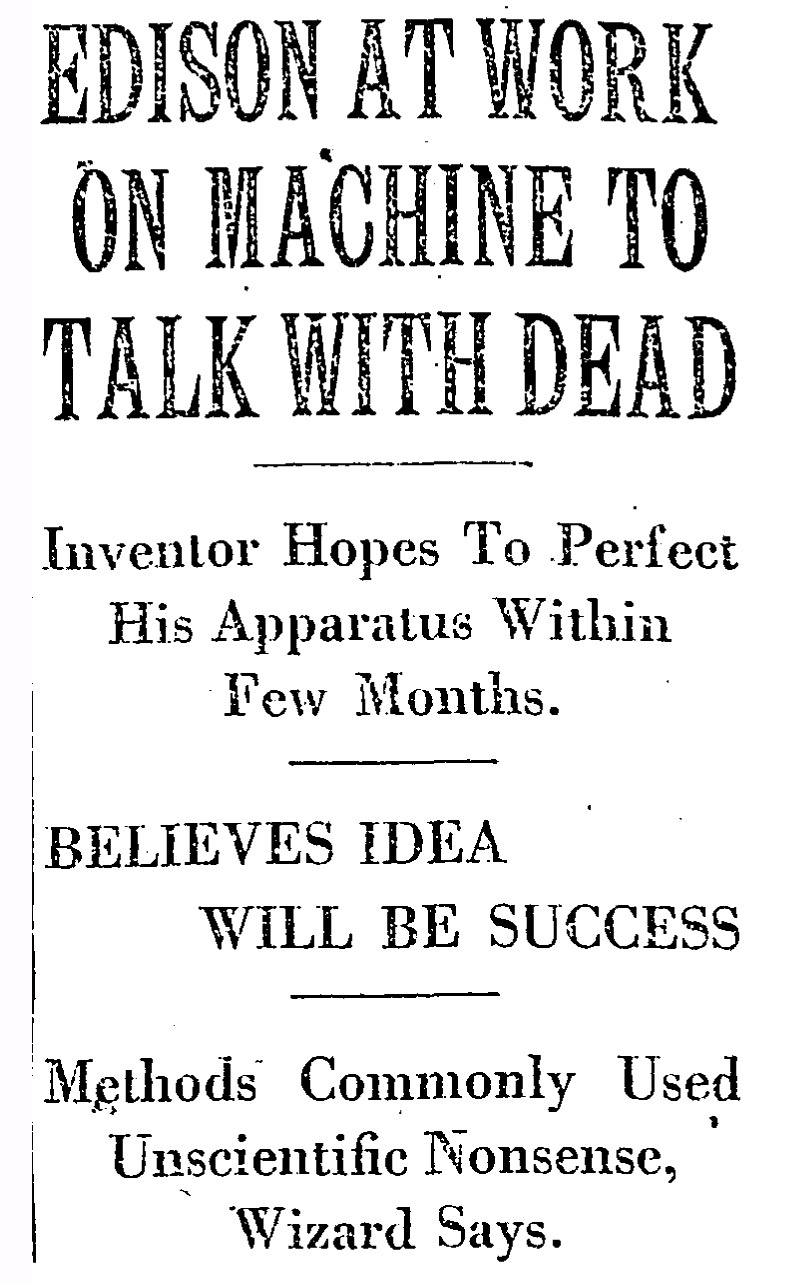
In an interview with the American Magazine, Thomas Edison announced that he was working on a machine to communicate with the dead, on the principle that a personality, if it survived, must still consist of ‘life units’ that could affect a sufficiently delicate instrument. The newspapers ran it everywhere. He never showed a device; his laboratory notes, published in 1948 as The Diary and Sundry Observations, describe the idea, and a chapter of them was left out of the American edition because it embarrassed the editors. Whether or not the machine existed, the announcement did: after 1920 it was respectable to try to reach the dead with electricity, and everything on this page for the next hundred years follows from it.
VIThe Spiritualist Century
Houdini versus Margery
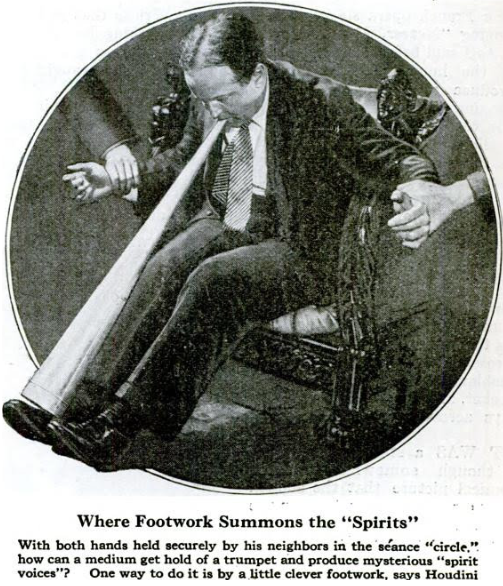
The Scientific American offered $2,500 for a physical medium who could pass its committee, and the wife of a Boston surgeon, Mina Crandon, ‘Margery’, nearly did, until Houdini joined the committee, built a cabinet she could not cheat in, and caught her ringing the bell-box with her foot. He then toured a stage show exposing mediums, with his assistants in the audience as spies, and published A Magician Among the Spirits. He also promised his wife a coded message from beyond the grave, and for ten Halloweens after 1926 she held a séance for it. It never came, or came once and was disowned. The greatest exposer of the dead spent his life hoping to hear from them.
Read: A Magician Among the Spirits (1924)Watch: Houdini and Margery
VIIThe Electric Dead
Jürgenson hears voices on the tape: EVP
Friedrich Jürgenson, a Swedish painter and film producer, recorded birdsong in his garden and on playback heard a man’s voice discussing birdsong in Norwegian. He kept recording, and kept hearing voices, including his dead mother’s, calling him by his childhood name. His book Voices from Space (1964) began electronic voice phenomena: the practice of recording silence, or radio noise, and listening for the dead in it. The Vatican was interested; the Pope gave him a medal for a film about the Vatican, which did not help the confusion.
Raudive’s Breakthrough
The Latvian psychologist Konstantin Raudive took Jürgenson’s method into the laboratory and recorded, he said, seventy-two thousand voices, in several languages at once, often in a peculiar clipped rhythm, and published Breakthrough in English in 1971 with a record of them. The publisher had the recordings tested in a screened room; the engineers heard voices and could not say where they came from. Critics said pareidolia, the mind hearing words in noise, which is real and powerful and explains most EVP. It does not explain all of it, and Raudive’s ‘diodes’ and the white-noise method are the direct ancestors of every recorder and spirit box in the ghost-hunter’s bag.
Spiricom: the two-way radio to the dead
George Meek, a retired engineer, and William O’Neil, a medium and radio ham, built a set of thirteen tone generators spanning the voice range and claimed that a dead physicist, ‘Doc Mueller’, spoke through it in a buzzing, mechanical voice, in real time, for twenty hours of tape. Meek gave the plans away free at a press conference in Washington in 1982. Nobody else ever got it to work, including Meek after O’Neil left. It remains the most ambitious claim ever made for a machine, and the recordings are online for anyone to judge.
ITC: the dead on television
Instrumental transcommunication was the name given in Germany and Luxembourg to the next step: voices on radios, faces on television screens tuned to static and filmed by a video feedback loop, text on computers. Klaus Schreiber in Aachen filmed faces in 1985; the Harsch-Fischbach couple in Luxembourg claimed a ‘timestream’ station transmitting from the other side; a mathematician named Ernst Senkowski coined the term. The pictures are, at best, ambiguous. The idea that the dead would use whatever medium I had just invented was already three thousand years old.
The psychomanteum: Moody brings back the mirror
Raymond Moody, the physician who coined the phrase ‘near-death experience’, built a dark room with a mirror angled so the sitter could not see themselves, a dim lamp behind, and a comfortable chair, and found that a majority of grieving people who sat in it for an hour reported seeing or hearing the person they had lost. He named it after the Greek oracles of the dead, and it is exactly what Dee did with the obsidian, what the Aztecs did with the same stone, and what the Greeks did at Ephyra: a reflective surface, low light, and a prepared mind. The oldest technique on this page, reissued with a bibliography.
Frank’s Box and the spirit box
Frank Sumption, a Colorado radio hobbyist, built a receiver that swept AM frequencies continuously and fed the fragments through a reverb, and said the dead assembled words from the scraps. He built a few dozen by hand and gave them away; the spirit box in every ghost-hunting kit since is a mass-produced imitation. It is Raudive’s radio method mechanised, and it produces, reliably, syllables. Whether they are answers is the question the method is designed to prevent you from asking.
Ghost-hunting television, and the meter
Ghost Hunters went on the air in 2004 and made the electromagnetic-field meter, the infrared camera, the digital recorder, and the spirit box into a costume. The EMF meter was designed to find wiring faults; the K2 lights up near a mobile phone; the ‘Ovilus’ of 2008 turns sensor readings into words from a dictionary. None of it is an instrument for talking to the dead. All of it is a setting, and a setting works, which is why the shows are still on. The people in them are doing, with meters, what the Fox girls did with a knock, and getting the same answers.
Griefbots: the dead as software
In 2020 a man in California fed his dead fiancée’s text messages into a language model and talked to her for months; the story ran in the San Francisco Chronicle and started an industry. There are now companies that will build you a chatbot of your mother from her emails, video avatars of the dead that answer questions at funerals, and in China a trade in ‘AI resurrection’ for a few hundred yuan. The machine says what she would have said, in her voice, from her words, and it is not her, and it is the letters to the dead of 2100 BC with the answer written by the bowl. It is also the first method on this page that does not need the living to move their own hands, and that is exactly what is wrong with it.